

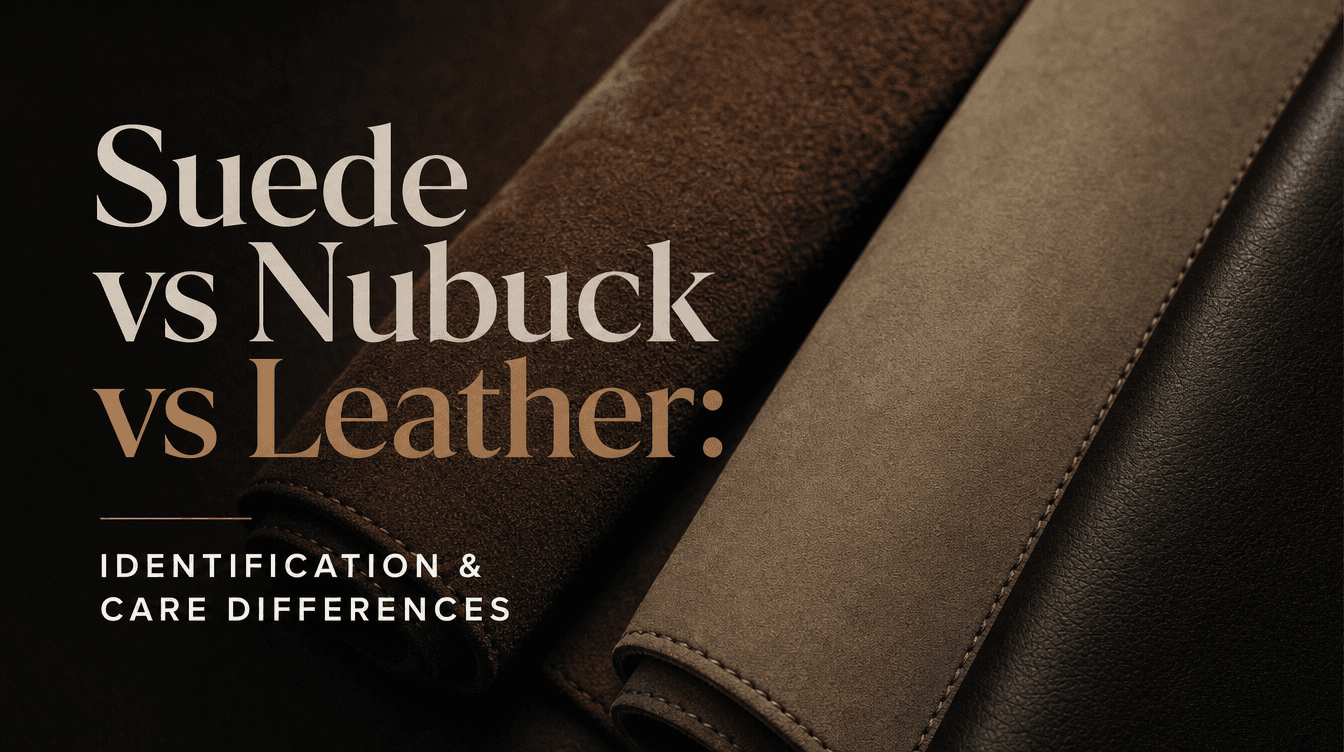
Suede vs nubuck comes down to which side of the hide has been buffed. Suede is the inner, flesh side, raised into a loose, longer nap that feels soft but wears quickly. Nubuck is the outer grain side, sanded into a short, tight nap that feels like velvet and lasts better. Smooth leather is that same grain side left unbuffed and usually given a finish on top. The three look related, but each one takes dirt, water and cleaning products in its own way, which is why identifying the material comes before any cleaning at all.
How the three materials are made
A hide has two faces. The outer face, the grain, is where the hair grew. It is the tightest, strongest part of the skin. The inner face, the flesh side, is looser and more fibrous. Thicker hides are often sliced horizontally into layers, and the lower layers, called splits, have no grain at all.
- Smooth leather keeps the grain facing out. It may be left close to natural or sealed with a coloured finish, but the surface is the original skin.
- Nubuck also keeps the grain facing out, but the grain is sanded lightly so it lifts into a very short nap. Because the grain is still there underneath, nubuck keeps much of the strength of smooth leather.
- Suede is made from the flesh side, most often from a split. The fibres are raised into a longer nap. There is no grain layer holding it together, so it is softer, more flexible and more fragile.
There is one more variant worth knowing. Roughout is a full-thickness hide turned flesh side out. It looks like a coarse suede but has the grain on the inside, so it is much tougher. It turns up on work boots and some outdoor footwear.
Suede vs nubuck vs leather at a glance
| Suede | Nubuck | Smooth leather | |
|---|---|---|---|
| Side of the hide | Flesh side, usually a split | Grain side, lightly sanded | Grain side, left smooth |
| Feel | Soft, loose, slightly shaggy | Fine and velvety, like peach skin | Smooth, cool, sometimes glossy |
| Nap length | Longer, uneven | Very short, even | None |
| Strength | Lowest | Good | Highest |
| Reaction to water | Darkens, can dry stiff with a tide line | Darkens and marks easily | Depends on the finish |
| Main enemy | Oil, grease and flattening | Oil, water and rubbing to a shine | Drying out and cracking |
How to tell them apart at home
Labels are often vague ("genuine leather" tells you nothing about the surface), so it is worth knowing how to check for yourself. Try these in order, and do anything involving water on a hidden spot.
1. Run a fingertip across it
Drag a finger lightly one way, then back. Both suede and nubuck will leave a visible track as the fibres change direction and catch the light differently. On nubuck the track is fine and crisp. On suede it is broader and softer. Smooth leather leaves no track.
2. Look closely at the surface
Nubuck often shows a faint trace of the grain pattern beneath its nap, sometimes with tiny pores visible if you tilt it towards a window. Suede shows nothing of the kind, because the grain was never on that side. A cluster of three small holes repeated across the surface usually means pigskin suede.
3. Check a cut edge or the inside
Find a raw edge on a seam allowance, a strap end or the inside of a shoe. Real suede and nubuck show a dense web of fibres at the edge. A fine woven or knitted backing means you are looking at a microfibre or other synthetic imitation, which needs very different handling.
4. The water drop test
On a hidden area, place one small drop of water and watch for ten seconds. If it soaks in and darkens the patch, the surface is open, as with suede, nubuck or unfinished aniline leather. If it sits as a bead, the leather has a sealed or pigmented finish. Blot it straight away with a dry cloth and let it dry naturally.
Caring for each material
Here is where the three differ most, and where most home damage happens.
Suede
- Brush dry, and brush often. A suede brush with brass wire or crepe rubber lifts dust and restores the nap. Work gently in one direction first, then across.
- Use an eraser on marks. A suede eraser, or a clean crepe block, rubs out a lot of surface dirt without any liquid.
- Keep oil away. Suede soaks up grease from hands, food and hair products, and it does not let go of it easily.
- Protect it before wearing. A proper suede protector spray, applied to clean, dry suede, buys you time with rain and spills.
For the detail on everyday cleaning, see how to clean suede shoes at home, and for specific marks, how to get stains out of suede.
Nubuck
- Use a softer brush. The nap is shorter and finer than suede, and a stiff brass brush can scar it. A crepe or soft nylon brush does the job.
- Use a nubuck cloth or eraser for marks, and work lightly. Heavy rubbing polishes the fibres flat and leaves a shiny patch.
- Watch the wear points. Toe caps, heel counters, bag handles and cuffs slowly go dark and slick as skin oil and friction burnish the nap. That is normal ageing, but it is much harder to reverse once it is deep.
- Treat water with respect. Nubuck marks from rain just as suede does, and a protector spray is worth using from new.
A word on oiled or waxed nubuck, common on work boots and some casual shoes. It has been deliberately loaded with oil or wax, so it looks darker and feels slightly tacky. It needs its own nourishing products, and the dry suede methods above will not suit it.
Smooth leather
- Wipe, don't scrub. A soft, barely damp cloth removes most surface dirt.
- Feed it occasionally. A good leather conditioner keeps the fibres supple and stops the surface drying and cracking at folds.
- Match the product to the finish. Pigmented leather tolerates most care products. Aniline and semi-aniline leathers, which have little or no protective coat, can darken or blotch with the wrong cream, so test first.
The most common mistakes with these materials
Avoidable damage to suede, nubuck and leather usually starts the same way, with the right product used on the wrong material:
- Leather cream on suede or nubuck. It mats the nap flat, darkens the colour and leaves a greasy patch that is harder to remove than the original mark.
- A brass brush on nubuck. Fine for many suedes, too harsh for the shorter nap, and the scratches show.
- Saddle soap or a wet cloth on suede. Water spread over part of a panel dries as a ring with a hard edge.
- Drying by a radiator. Heat makes all three stiffen and shrink, and it is the fastest way to crack smooth leather.
- Assuming a mixed item is one material. A single pair of boots can have nubuck uppers, suede trims and smooth leather heel tabs. Each panel wants its own treatment, and one product across the lot will spoil at least one of them.
When to send it to a specialist
Home care works well for dust, light scuffs and keeping things protected. It is not the right tool for oil and grease stains, water tide lines, colour loss, a burnished shine on nubuck, or anything where you are unsure what the material is. Those jobs need the whole panel treated evenly and, often, colour and nap restored afterwards.
If you have an item you are not sure about, our workshop handles all three: suede, sheepskin and shearling garments, smooth and nubuck leather garments, and shoes, boots and designer trainers. Bags come under our handbag cleaning service. Every piece is inspected when it arrives, before any work begins, which matters most when the label and the material do not agree.