
Serving Chelsea & Kensington
Designer Item Cleaning in Chelsea & Kensington
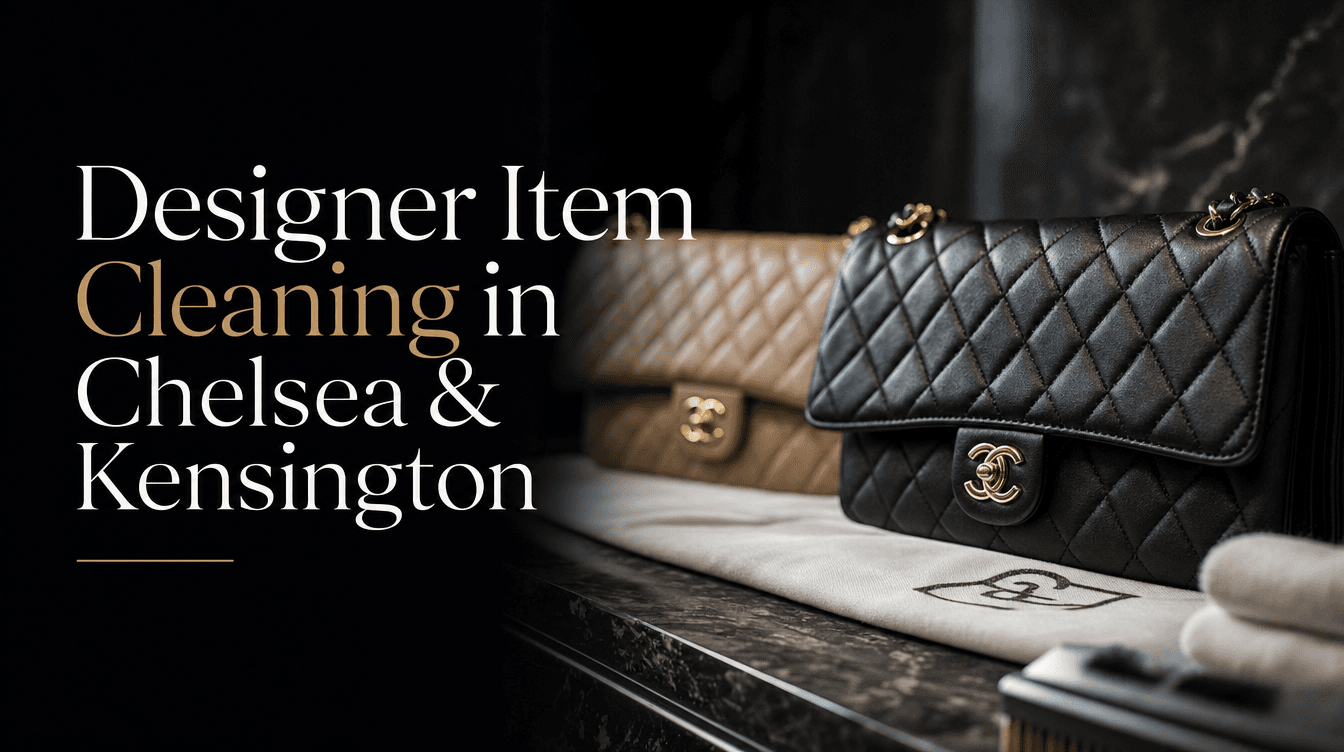
Designer item cleaning in Chelsea and Kensington is mostly about knowing when to stop. Luxury handbags, loafers, shearling and furs are made from the softest skins and thinnest finishes a maker can buy, so the aim is to take off the dirt without taking off the character. We collect from your door, inspect every piece before any work begins, clean it at our own workshop and bring it back.
We are an independent workshop with no connection to any fashion house.
What designer item cleaning in Chelsea and Kensington involves
Luxury leather is chosen for how it feels, not how it wears. Lambskin, fine calf and unlined suede are soft in the hand because they are thin, lightly finished and barely sealed. That is exactly what makes them lovely to own and unforgiving to clean.
Three things follow from it:
- There is less surface to work with. A heavy biker hide can take a firm brush. A lambskin flap cannot, and a scrub that would lift grime from one lifts colour from the other.
- Colour often sits on top, not through. Many pale and pastel leathers are coloured with a thin finish over a lighter hide. Solvents strong enough to shift a stain can shift that coat with it.
- Water leaves a mark. Unsealed suede and nubuck take up moisture unevenly, so spot cleaning a single mark usually replaces it with a ring.
Pieces like these call for slower, more cautious work than everyday leather, and any product should be tried on a hidden area before it goes near the visible surface.
Handbags: the leather decides the method
The name on the clasp tells us very little. What matters is the skin and how it has been finished, and one bag can carry three or four different materials.
| Leather type | How it behaves | What that means for cleaning |
|---|---|---|
| Lambskin (often quilted) | Very soft, scuffs and marks easily | Gentle surface cleaning only, and corners are the first to show wear |
| Grained or pebbled calf | Textured, hides light scratches well | Dirt sits in the grain, so it needs working out rather than wiping |
| Smooth box-style calf | Glossy, shows every mark | Cleaning is careful, and deep scratches are a finishing job, not a cleaning one |
| Suede or nubuck | Open nap, soaks up oils | Dry methods first, liquid only where it will not leave a ring |
The parts people forget are often where a bag looks tired first. Handles darken from hands and hand cream. Painted edges crack at the folds. Lining picks up make-up and pen. Metal hardware is plated, and polishing compounds that brighten it can strip it, which is why clasps, buckles and fasteners are protected during cleaning rather than buffed.
Our handbag cleaning service covers the bag itself, and belts, wallets, gloves and small leather goods come under bags, belts, gloves and accessories. For a longer look at what can and cannot be saved on a marked bag, read suede handbag stained? what a specialist can save.
Some of the big houses run their own aftercare through their boutiques. For a recent bag, especially one with an unusual finish or exotic skin, that route is worth considering alongside an independent specialist.
Unlined suede loafers and driving shoes
The softest shoe in a Chelsea wardrobe is usually the hardest one to clean. Unlined suede loafers are made to be worn without socks, so the inside takes on sweat and the outside picks up pavement dust, rain and the odd splash of wine at a garden party.
Because there is no lining, whatever goes on the outside can soak straight through to the foot bed, and the other way round. That rules out the soak-and-scrub approach. The inside and the outside need treating as separate jobs, with the moisture kept to the minimum, and the pair should dry on shaped trees so the soft upper does not collapse or shrink.
Pale colours such as sand, taupe and light grey show every mark and every uneven patch. Grass and mud from the lawns at the Royal Hospital in Flower Show week, or dust from the gravel paths in Kensington Gardens, are both manageable if the pair comes in before the marks have been rubbed at. A damp cloth on pale suede is how a small mark becomes a large one.
The same care applies to suede ankle boots, velvet slippers and designer trainers, all of which sit under shoes, boots and designer trainers. If you want the detail on mixed-material trainers, our guide to designer trainer cleaning works through each panel in turn.
Cashmere and knitwear with leather, suede or fur trim
Mixed materials are where standard dry cleaning most often goes wrong. A cashmere coat with a suede collar, a knit with leather patches or a gilet with a fur hood each have two parts that want opposite treatment. The process that suits the cashmere can strip oils from the leather, bleed dye from a suede trim onto the knit, or flatten fur.
The safe approach treats them as two jobs in one piece: the trim is protected or cleaned by hand while the main garment is dealt with, then each is finished on its own terms. That work is set out under garments with leather, suede or fur trim.
Shearling, sheepskin and fur
Shearling coats, fur jackets and fur-trimmed parkas usually come out of storage around October, after months shut in a wardrobe. Many furs are older pieces passed down through a family, and older skins need gentler handling because the leather side may already be dry.
What needs checking first:
- The leather side of fur. If it is brittle or papery, cleaning can still go ahead, but no cleaning can make an old skin young again.
- Moth. Warm, rarely opened wardrobes suit clothes moth well. Bare patches on fur, or small holes along the seams of a shearling, need treating before the coat goes back in a cupboard, through our moth treatment and prevention service.
- The collar and cuffs. Make-up, scent and skin oils collect there on shearling, and they need cleaning out rather than covering up.
Shearling and sheepskin are handled through suede, sheepskin and shearling garments, and furs through fur cleaning.
Where storage goes wrong in this borough
The Royal Borough is not short of wardrobe space, but a lot of it sits where leather does not like to live.
Basement dressing rooms. Many houses here have been dug down a floor or two, and some of those rooms are cooler and damper than the rest of the house. A pale bloom on a bag or a musty smell in a jacket after a season downstairs is usually surface mould. It is treatable, and the steps are set out in mould and mildew on leather.
Warm, sealed flats. The opposite problem shows up in mansion blocks and new apartments with constant heating. Leather kept near a radiator or in a heated cupboard dries out, stiffens and eventually cracks at the folds.
Long absences. When a house or flat is shut for months over summer or winter, nothing gets aired. Bags stored stuffed with tissue in their dust bags are fine. Bags stored in plastic, or with the handles crushed flat under something heavier, are not.
The simple rule: somewhere cool, dry and dark, with air around it, and never in a plastic cover.
Before you hand anything over
A few minutes of preparation makes a designer piece easier to look after and easier to account for:
- Take a few photos of the item from each side, including any marks you already know about.
- Keep receipts, authenticity cards and boxes at home. We do not need them to clean the piece, and they are safer with you.
- Empty every pocket and compartment, including the small inside zips on bags.
- Tell us about previous work. A bag that has been recoloured or a coat that has been relined somewhere else behaves differently, and it helps to know before we start.
- Send detachable straps or belts only if they need cleaning too. Otherwise keep them at home.
Every piece is inspected and photographed when it arrives, and if that inspection shows a risk with the treatment, we contact you about it before any work begins.
Collection across Kensington and Chelsea
Our van collects throughout the Royal Borough and the areas that border it:
- SW3 Chelsea, the King's Road and Sloane Avenue
- SW10 World's End and the Fulham Road end of Chelsea
- SW7 South Kensington and the museum streets
- SW5 Earl's Court
- SW1X Knightsbridge, Sloane Street and Belgravia
- W8 Kensington High Street, Kensington Church Street and Phillimore
- W11 Notting Hill, Holland Park and Portobello Road
- W10 and W14 North Kensington and West Kensington
Collection and return cost nothing once an order reaches £50. Under that, one flat £10 pays for both journeys, however many pieces you send.
Things kept at a house outside London can come to us by our tracked postal service instead, so a coat left in the country does not have to wait for your next trip into town.
Visiting the workshop
The bench is in Edmonton, at Unit F23a, Hastingwood Trading Estate, 35 Harbet Road, London N18 3HU. Opening hours are 9am–3pm on weekdays; we are shut on Saturdays, Sundays and bank holidays. Please call 0208 981 3232 before setting out.
From the King's Road it is a long drive across town, so from this part of London the collection service is usually the easier option.
Frequently asked questions
- Do you collect designer items from Chelsea and Kensington?
- Yes. Our van collects across SW3, SW5, SW7, SW10, SW1X, W8, W10, W11 and W14. There is no charge for collection and return on orders of £50 upwards, and a flat £10 covers both journeys on smaller orders.
- Can you clean a luxury leather handbag without damaging the colour?
- Every bag is inspected before any work begins, and the right method depends on the leather and its finish rather than the brand. Some change in colour is always possible when leather is cleaned, and if the inspection shows a risk, we contact you before starting.
- Are you connected to any of the fashion houses?
- No. Ace of Suedes is an independent leather and suede workshop. Some fashion houses offer their own aftercare through their boutiques, which is worth considering for a very recent piece.
- Can unlined suede loafers be cleaned?
- Yes, but with care. With no lining, the inside and outside need treating separately with as little moisture as possible, and the pair should dry on shaped trees so the upper keeps its form.
- Should I send the authenticity card or box with my bag?
- No. Keep receipts, cards and boxes at home. We only need the item itself, plus any detachable straps that also need cleaning.
- My bag has been kept in a basement and smells musty. Can it be saved?
- Usually. A musty smell and a pale bloom on the surface are signs of mould, which is treatable when caught early. Stop using the bag, keep it away from other clothes and have it looked at before the growth settles further.
- Do you clean fur and shearling as well as bags?
- Yes. Shearling, sheepskin and fur coats are all cleaned at our workshop, along with fur trims on cashmere and knitwear. Older furs are checked first, because a dry leather side needs gentler handling.
- Can I bring items to your workshop instead?
- Yes. The workshop is at Unit F23a, Hastingwood Trading Estate, 35 Harbet Road, London N18 3HU, and is staffed on weekdays between 9am and 3pm. Ring 0208 981 3232 before you travel so someone is expecting you.