

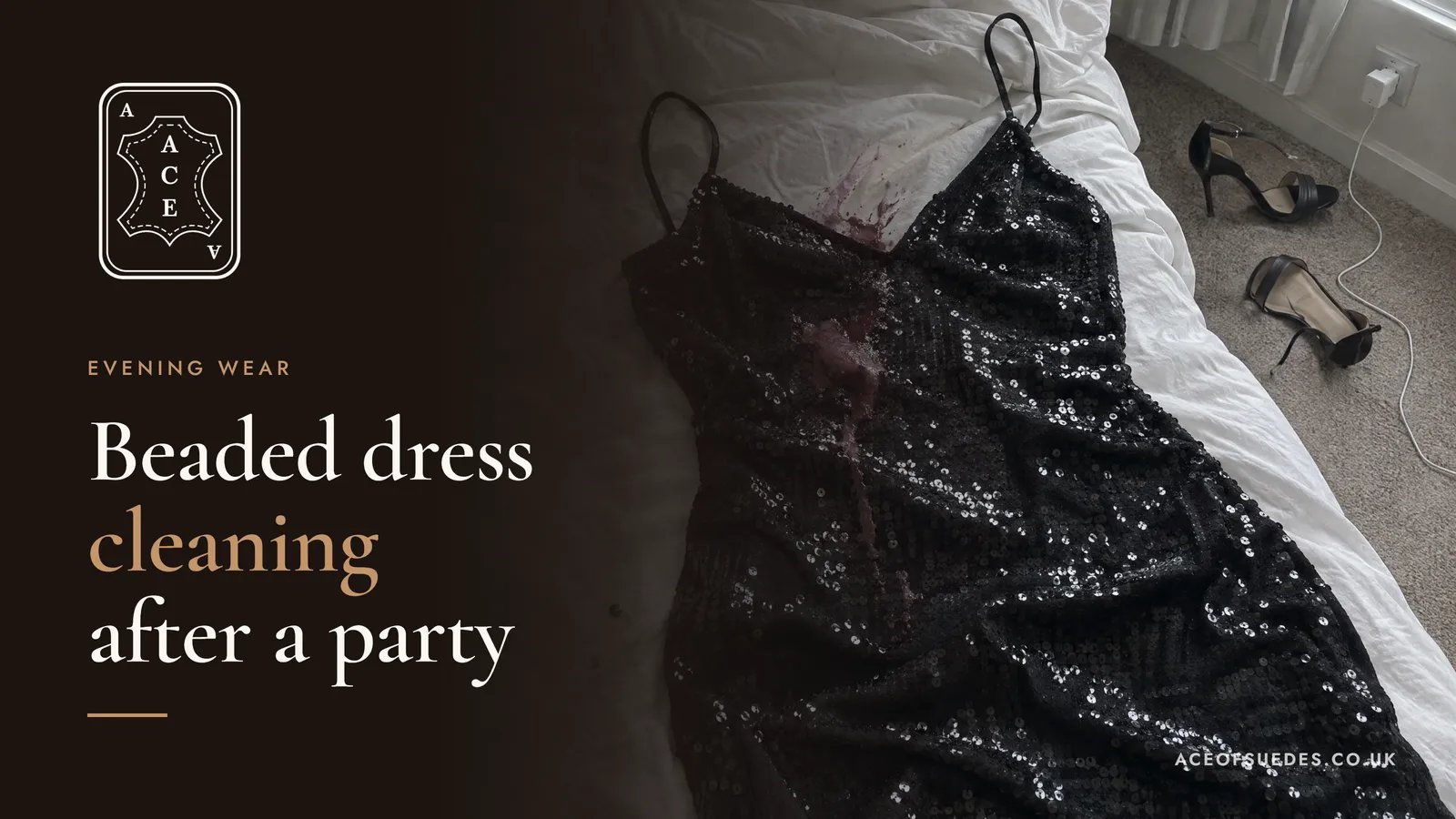
The morning after a good night, a sequinned dress with a sticky patch down the front and a few sequins on the bedroom carpet looks a lot worse than it usually is. Put the washing-up liquid down. The easiest way to spoil one is in that first hour, scrubbing at a mark and dragging on the threads that hold the beads, and honestly, good beaded dress cleaning starts with doing very little on the night. Blot what you can with a clean, dry cloth, let the dress dry lying flat, and leave it be. Tomorrow, have a look at the label. If it says dry clean only, or the beading is heavy or glued on, get it to a specialist sooner rather than later, because sugary drinks especially don't improve with time.
The first night: what to do before you go to bed
It's tempting to deal with it properly at midnight, but tired hands and a delicate dress are a bad mix. What you want is to stop the damage spreading and nothing more.
Take the dress off carefully, ideally over your head rather than stepping out of it, so a heel doesn't catch the hem. If something has been spilt on it, press a clean white cloth or a bit of kitchen roll onto the mark and lift it straight off. Don't rub. Rubbing pushes the liquid further into the fabric, and on a beaded panel it saws the cloth against the thread, which is how a single bead becomes a little trail of them on the carpet.
Then lay it out flat somewhere it won't get sat on (a spare bed or a clean towel on the floor will do) and let any damp patches dry in the air. Keep it away from the radiator and don't try a hairdryer. Heat is bad news here for two reasons: plenty of sequins are plastic and can curl or dull with heat, and it can set a stain you'd otherwise have had a fair chance of shifting.
If you find loose beads or sequins on the floor, pop them in an envelope. Matching a bead later can be surprisingly hard, and the ones that came off your own dress are the best match you'll ever get.
Why the drink you can't see is the one to worry about
Red wine announces itself. A splash of prosecco, lemonade or a sweet cocktail usually doesn't, because it dries clear and you forget all about it. The trouble is that sugar left in fabric can turn yellow or brown as time goes on, and heat (including the heat of a clean) brings it out faster. By the time you take the dress out for the next wedding, there's a tan mark on the skirt and nobody can remember what it was.
That's the main reason we'd say don't hang a party dress back in the wardrobe and assume it's fine because it looks fine. If you know a drink went over it, even a clear one, mention it when you hand it in, and say roughly where. A cleaner who knows there's sugar in that spot can treat it before the main clean rather than finding out afterwards.
Make-up, fake tan and deodorant round the neckline and underarms are the other usual suspects, and hairspray and perfume are worth keeping off sequins and metallic thread anyway. None of these needs a rescue mission that night, but they all come out more easily if they haven't had months to settle in.
Read the label, then look at how the beads are attached
The care label is your starting point. A plain circle with a P or an F inside means professional dry cleaning, the F meaning the gentler hydrocarbon solvent. A circle with a cross through it means don't dry clean at all, and a little tub of water means it can be washed, at the temperature shown. Bear in mind the label is often written for the base fabric, and some cheaper embellished dresses carry a label that doesn't really account for what's been stuck on top.
So turn the dress inside out and have a proper look at the back of the beadwork. You're checking for two things.
- Sewn or glued. Sewn beads and sequins have thread running between them on the reverse. Glued ones (often flat-backed stones or heat-set sequins) just sit on the surface, and if you look closely you can sometimes see a faint ring of glue around each one. Glue softens with heat, and some adhesives don't cope well with solvent either.
- The state of the thread. Gently run a finger along a few rows. If the thread is fraying, or a row moves when you touch it, the beading is already under strain. Any clean, by anyone, puts some stress on that thread.
It's also worth knowing that some beads and sequins have a colour or metallic coating rather than being coloured all the way through. Those coatings can rub, peel or lose their shine if they're handled roughly, which is one more reason a cleaner should be testing first rather than guessing.
Can you hand wash a sequinned dress yourself?
Sometimes, yes. Not everything with a bit of sparkle on it needs a specialist, and we'd be fibbing if we said otherwise. If the label shows a hand wash symbol, the base fabric is something sturdy like polyester or a cotton jersey, and the sequins are clearly sewn on, a careful hand wash can be perfectly fine.
Turn it inside out first. Use cool water and a small amount of a gentle liquid detergent, swish it about rather than scrubbing, and keep the soak short. Rinse in cool water, then press the water out without wringing or twisting. The easiest way is to lay it on a towel, roll the towel up and press down. Dry it flat, reshaping it as you go, and never in the tumble dryer or on a hanger while it's heavy with water, because the weight pulls the shoulders and stretches the fabric between the rows of beads.
Leave it to a specialist if there's silk, chiffon, georgette, velvet or lace underneath the beadwork, if it's labelled dry clean only, if the stones are glued, if it's beaded all over, or if you'd be heartbroken to lose it. Also leave alone any dress where the beads look like painted or dyed wood or glass, because the colour can bleed into the fabric around it once it's wet.
What beaded dress cleaning involves at a specialist
A good specialist won't just put your dress through with everything else. Before any cleaning, the beadwork and seams should be looked over, marks noted, and the process chosen to suit the fabric, the trims and the label, rather than the other way round. With beaded and sequinned pieces that often means a mild solvent process rather than a standard dry clean, and careful finishing afterwards, because you can't just run a hot press over sequins.
Our specialist cleaning for evening wear and beadwork covers exactly this sort of work: cocktail and evening dresses, beaded and sequinned garments, wedding dresses, sarees and other traditional wear. Dry cleaners, retailers and designers send us this kind of work, and so do private customers with just the one dress that matters to them. If your label specifically says F, our F clean service uses the mild hydrocarbon process that symbol asks for.
We'll be honest about the limits too. Nobody can promise that every mark will come out, especially a stain that's been in for months or has been heated. And with any beaded garment, a thread that was already worn can let go during cleaning, so a few beads or sequins may come loose. We'd much rather talk that through with you before we start than surprise you afterwards.
Sarees, lehengas and heavily worked traditional wear
Wedding and festival outfits are often the heaviest and most valuable beaded pieces anyone owns. A saree or lehenga can carry stonework, mirror work, sequins and zari (metallic thread) all on one length of silk or georgette, and each of those reacts a little differently to cleaning.
Zari in particular can tarnish or lose its shine, and it doesn't take kindly to being crushed or scrubbed. Mirror pieces have edges that can catch neighbouring fabric. And because these outfits tend to be worn for a long day with food, henna and heat, they usually come back with more than one kind of mark at once. If that's your situation, please don't try a home wash on a silk saree to get it ready for the next function. Send it to us as it is and tell us what you know about the marks.
Storing it until the next big night
Once it's clean, where you keep it matters almost as much as how it was cleaned. A heavily beaded dress shouldn't hang by its shoulders for months on end, because the weight slowly drags the fabric down and can pull the seams out of shape. Folding it loosely with acid-free tissue paper between the layers, then laying it flat in a box or drawer, is the safer bet. If it has to hang, use a padded hanger and the inner hanging loops if there are any, so the waist takes some of the weight.
Keep it out of the dry cleaner's plastic bag for long-term storage too. Plastic traps moisture, and a dress that can't breathe can end up musty or yellowed. A breathable fabric cover is much better, and you can add one when you book a clean with us. Somewhere cool, dark and dry is the ideal, away from a sunny window that can fade the fabric and dull coated beads.
If you're putting a wool shawl or a fur stole away alongside it, have a read of how to deal with moths in wool, fur and sheepskin, because moths love a quiet wardrobe that nobody opens till next December.
Collection in London, or send it by post
We're in Edmonton, N18, and we collect from a big stretch of London, with North London right on the doorstep. Inside that area we'll pick the dress up and drop it back for nothing once the order comes to £50 or over. If you're further away, our postal service means you can send a dress in from anywhere in the UK with tracked return postage.
Either way, pack any loose beads you saved in with the dress, point out where the drinks and make-up went, and we'll take it from there.