

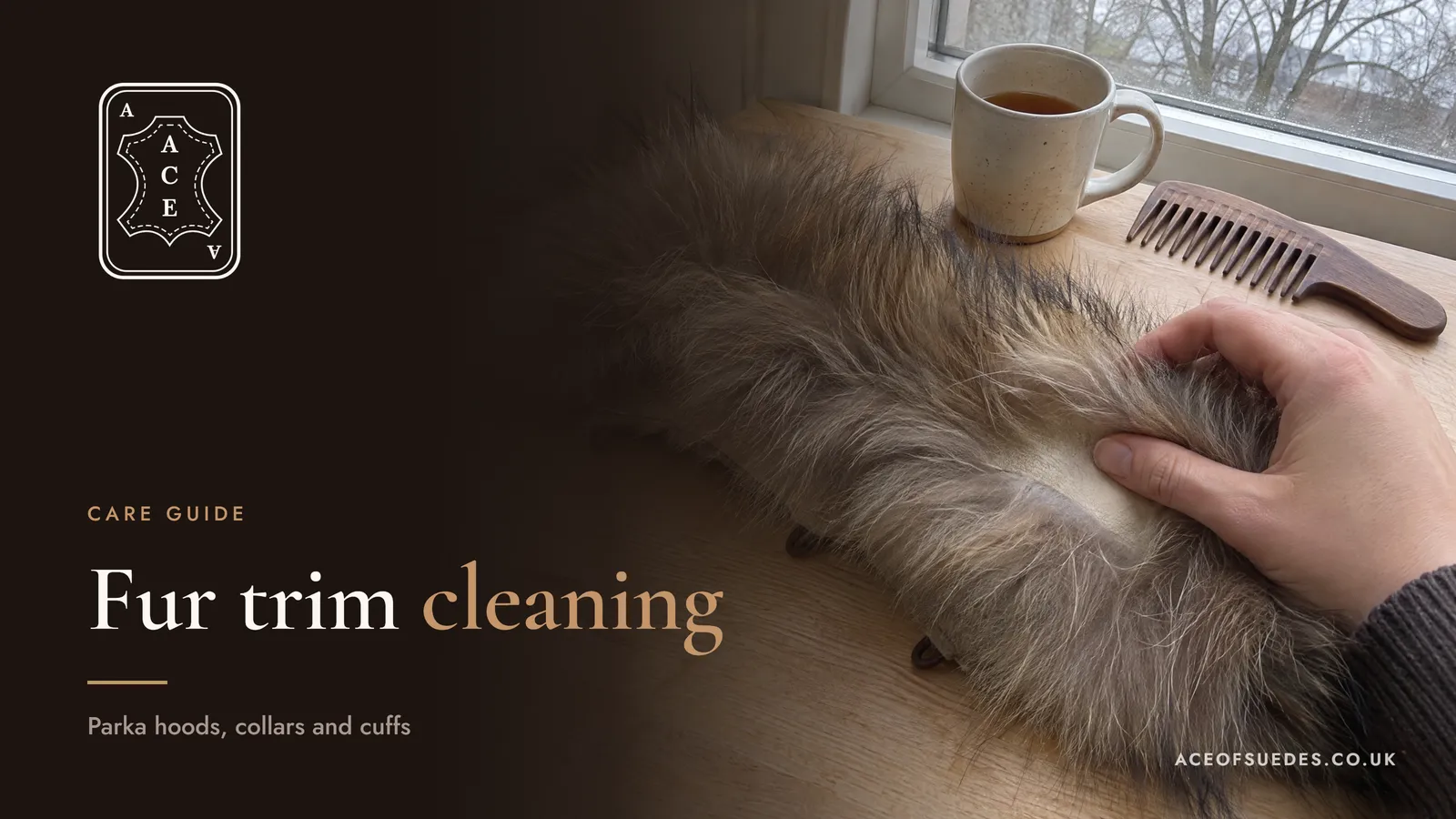
If the fur on your parka hood has gone flat and grey where it rubs against your face, or a collar has picked up a beige line of make-up, a lot of that can be sorted, as long as you don't make it worse first. The thing to get right before any fur trim cleaning is which kind you've got, because real and faux fur need quite different care. Real fur grows out of a thin leather skin, so water and heat are both off limits. Faux fur is a synthetic pile on a fabric backing, and while some of it will take a gentle wash, heat spoils it for good.
Whether the trim comes off the coat matters nearly as much, so check that while you're at it. Day to day, a good shake and a gentle comb once it's dry is most of what a trim needs. But if it's matted, stained or smelling of damp, or it's sewn on for good, honestly, you're better off handing it to a specialist than having a go yourself.
Is it real fur or faux? Find out first
From a metre away the two look much the same, so take a minute to check which one is on your hood. These are the checks worth doing, roughly in this order:
- Part the hairs and look right down at the base. Real fur grows out of skin, which looks like thin, pale leather, whereas faux fur is anchored into a woven or knitted fabric and you can usually see the threads.
- Look at the tips. A natural hair usually tapers to a fine point (unless the fur has been sheared), while synthetic fibres are cut, so their ends tend to be blunt.
- Compare the lengths and colours. Real fur usually has a soft underfur close to the skin with longer guard hairs over the top, often shading in colour along each hair. Faux pile tends to be more even in length and tone, though a good faux fur can copy all of this pretty closely.
- Read the label. Under textile labelling rules, a garment with real fur on it should carry the words "contains non-textile parts of animal origin". On a second-hand coat that label is often missing or cut off, so treat it as one clue alongside the others rather than the final word.
You'll see some guides suggest singeing a couple of hairs, because real fur smells like burnt hair while synthetics melt. We'd only try that if the checks above have left you genuinely stuck, and then only on a single hair pulled from a hidden spot on a coat you own.
Does the trim come off the hood?
Plenty of parka ruffs are made to come off. Run your fingers along the edge of the hood and look for a zip, a row of poppers, buttons or small loops through the fabric. Collars and cuffs on wool coats sometimes detach the same way, and the poppers can be tucked away under the fold, so have a proper feel before you decide it's fixed in place.
If it does come off, take it off before the coat is cleaned and life gets a lot easier, because the coat can be cleaned the way its own label says while the fur is looked after separately, and neither has to compromise for the other.
When the fur is stitched into the seam, though, the whole garment has to be cleaned in a way that suits its most delicate part, and that's nearly always the trim. It's the main reason a coat with a sewn-in collar shouldn't go in the washing machine, even when the shell fabric on its own could cope.
Why the trim gets dirty so much faster than the coat
Think about where a hood ruff spends the winter, right round your face. It picks up foundation, moisturiser, hair products and perfume, plus the natural oils from your skin and hair, and on top of all that it gets rain, sleet and city grime. Collars rub against your neck all day, and cuffs take a beating from wrists, gloves and bags.
So you usually end up with a band of flattened, greyish fur along the inner edge of the hood, a beige tide line on a collar, or clumps where wet fur dried pressed together. Because skin oils and make-up attract dust, a dirty patch tends to get darker as the season goes on, and soiled fur is more at risk from clothes moth larvae as well.
Fur trim cleaning at home: what's safe to do yourself
Home care is really about keeping the fur dry and free of dust so the hairs stay loose and move freely. It won't shift oily make-up or a stain that has set in, and trying harder only roughens the hair, so it helps to know where to stop.
Real fur trims
- Give it a shake. A few sharp flicks of the detached trim (or the hood, if it doesn't come off) knock out loose dust and lift the hair.
- Comb it only when it's bone dry. Use a wide-toothed comb and work in the direction the hair lies, starting at the tips and moving towards the skin in short strokes. Never drag a brush through it.
- Lift surface dust by patting gently with a clean, dry, light-coloured cloth, and resist the urge to rub.
- Leave the skin alone. That means no water, soap, wet wipes or stain remover, because liquid soaks through the hair into the leather underneath, and that leather can stiffen and shrink as it dries.
Faux fur trims
- Check the care label first. Some faux trims are fine hand washed in cool water with a mild detergent, but others are bonded to a backing that comes apart when it gets wet. If the label says dry clean only, or there isn't a label at all, don't wash it.
- If washing is allowed, keep it cool and gentle. Swish it about without scrubbing or wringing, then press the water out between two towels.
- Lay it flat on a towel to dry in a normal room, well clear of the hairdryer, the radiator and the tumble dryer, and turn it every so often. Heat can melt or frizz the fibres, and there's no undoing that.
- Once it's dry, run a wide-toothed comb through it to lift the pile back up.
Drying a fur hood after rain or snow
Getting caught in a downpour with a fur hood up is miserable, and what you do in the next hour or so decides whether the ruff comes back to normal or doesn't.
Shake the water out straight away, outside or over the bath, then hang the coat on a proper hanger with the hood hanging free and some air moving round it. Don't fold the hood down onto the coat or stuff it in a bag. After that it's a waiting game. Let it dry naturally, however long it takes, well away from radiators, fires, heaters and sunny windowsills, and leave the comb alone until it's completely dry, because wet hairs clump and stretch and combing them then just pulls them out.
If real fur has got soaked right through to the skin, though, don't just hang it up and hope. Get it to a specialist as soon as you can. And if the trim still smells musty once it's dry, or the skin feels stiff or brittle when you gently bend the edge, it needs a professional clean rather than another go at home.
Easy mistakes that ruin a fur trim
The biggest one is putting the coat in the washing machine with the trim still attached. Even on a wool cycle, real fur skin can shrink and harden, and faux pile can mat and frizz beyond repair. Close behind it is reaching for the hairdryer to speed up drying, which dries out the skin on real fur and can melt the fibres on faux.
Smaller habits do damage too, usually with the best intentions. If you spray perfume or hairspray with the coat already on, the alcohol stiffens the hair and dries out the skin underneath, so put them on first and the coat after. Scrubbing at a make-up mark pushes the oily make-up deeper and roughens the hair around it, and it's far better left for a cleaner who can lift it out.
Storage catches people out as well, from plastic bags to packed wardrobes, and we've covered how to put a trim away properly at the end of this guide.
When the collar or cuffs are sewn on
A wool overcoat with a fur collar, a cotton parka with a fur hood or a knitted cardigan with a fur-trimmed hood all mean the fabric and the fur get cleaned together, so the process has to suit both. What's fine for a grubby wool body can stiffen fur skin, while a process designed for fur may barely touch the wool.
That's exactly the job our garments with leather, suede or fur trim service is for. We use a mild process that cleans the whole garment while keeping the trim's texture and colour, then finish the fabric and the fur each the way it needs. Jackets, knitwear, tops, dresses and more with a trim all come under it, as well as coats.
A coat made entirely of fur, or lined with it, is a different job, and that one is booked under fur cleaning instead.
How a professional cleans real fur
Real fur isn't washed at all. The traditional furrier's method is to tumble it in a drum with fine sawdust or ground corn cob that has been dampened with a dry cleaning solvent. As the drum turns, the sawdust scrubs the hairs and picks up dirt and grease, but it leaves the skin's own oils in place underneath. After that the fur is shaken out in a mesh drum, blown clean with air and finished, often with steam, so the hair lies properly again.
Our own fur cleaning works along similar lines, with a deep clean, then re-oiling, brushing and finishing. If a fur is older and wouldn't stand up to a full clean, we go gentler, with oiling, tumbling, brushing and ozone instead.
We'd rather be straight with you about what cleaning can do. It can get rid of grime, make-up, odour and matting, and bring the movement back into the hair. What it can't do is replace hair that has broken off or been pulled out, or bring back skin that has already dried and cracked. And if a trim needs a new zip or new studs, or a rip or tear mending, that's one for our repairs and alterations team.
Getting a fur-trimmed coat to us
If you're within our London collection area, we can pick the coat up and bring it back once it's done. Collection costs nothing once your order reaches £50, and it's £10 below that. Our North London coverage page shows the areas around the workshop in Edmonton. Further afield, our postal service works from anywhere in the UK, so you post the coat to the workshop and we send it home tracked.
Putting a fur-trimmed coat away for the summer
When the cold weather is finally over, get the trim cleaned before the coat goes away. Clothes moth larvae eat the fur itself, and dirty fur is more likely to be attacked. Our moth damage treatment article goes into spotting and treating the damage, and why lost hair doesn't grow back.
Once it's clean, hang it uncovered in a cool, dark wardrobe with a bit of space around it, or under a loose cotton cover over the shoulders, and never in plastic, because fur needs air moving around it and plastic can dry the skin out. Give the hood enough room that the ruff isn't pressed flat against the next coat along, since a ruff crushed for months can stay that way. Lofts and garages are a bad idea because the temperature and humidity swing about, and so is direct sunlight, which can discolour fur. If the trim comes off, keep it loosely in its own cotton bag beside the coat rather than folded into a drawer.
When autumn comes round, our winter coat cleaning and prep guide covers getting sheepskin, fur and leather coats ready for the cold again. And if your trim's already past what a comb and a bit of patience can fix, send it our way and we'll give you an honest view of how much a clean will bring back.