

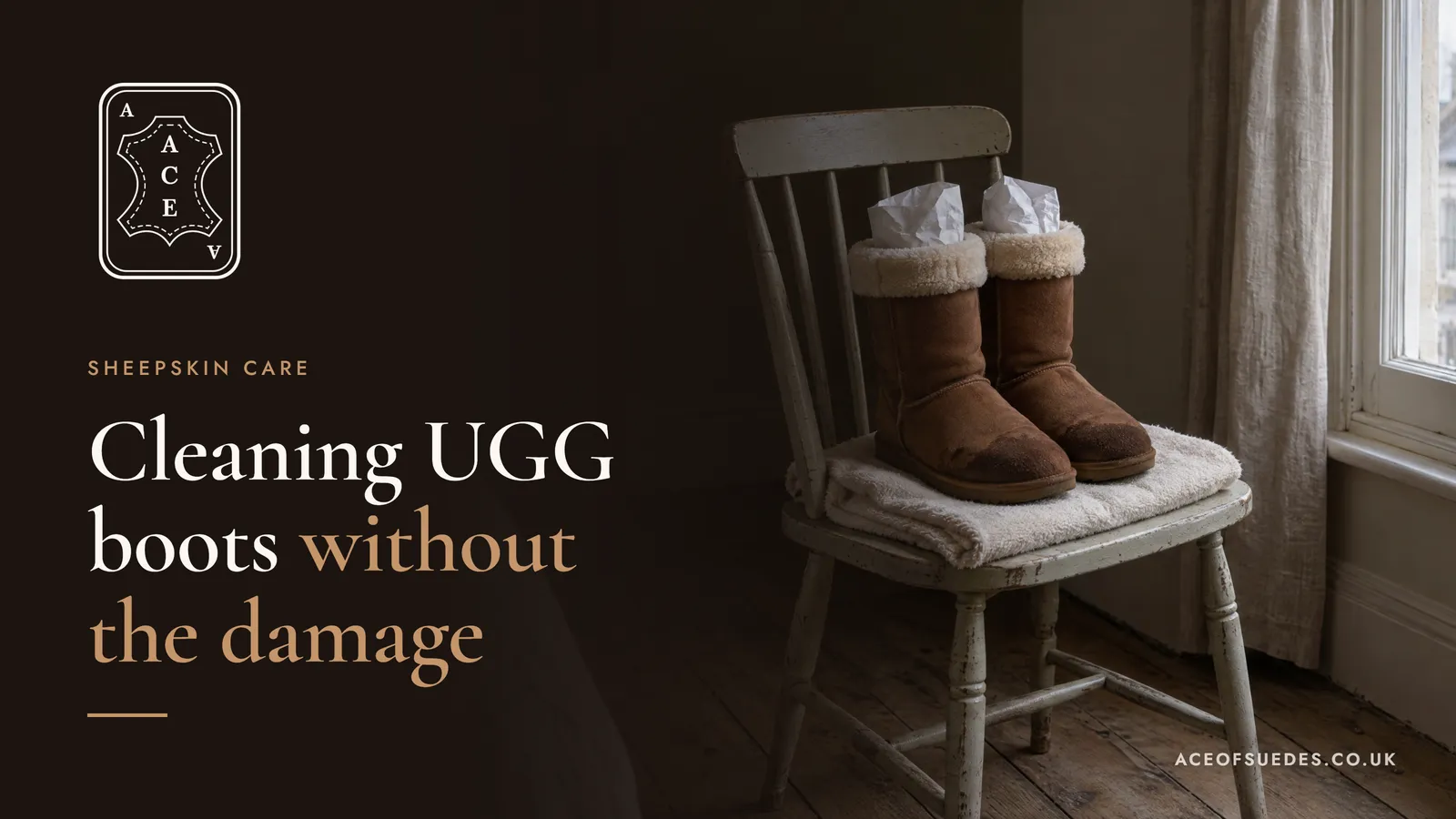
To clean UGG boots safely, treat them as sheepskin, not as shoes. Let them dry fully, brush the suede outside with a soft brush, lift marks with a little sheepskin cleaner on a sponge so the whole panel dampens evenly, then dry them slowly at room temperature. Never put them in a washing machine, never dry them on a radiator, and send them to a specialist once the fleece is matted, the suede is stained dark or the smell will not shift.
Why are UGG boots so easy to ruin?
The short answer is that the boot and its lining are the same piece of skin. A classic UGG-style boot, and most other sheepskin boots built the same way, is cut from twin-face sheepskin: the skin of a sheep tanned with its wool still attached, sanded to a suede finish on one side while the fleece stays on the other. There is no separate lining to protect.
That causes three problems.
- Water travels straight through. Wet the suede heavily and you have also wet the fleece behind it, which then holds the moisture for hours. Uneven wetting is what leaves the dark patches and pale rings people try to clean off afterwards.
- The skin depends on its oils. Sheepskin stays soft because the tanning process feeds it with fats. Strong detergents and heat both pull those out, and a boot that has lost them dries stiff and creased.
- The colour is not fixed like paint. Dyed suede can move when it gets soaked, so a heavy-handed clean can leave a patchy upper or a tinge of colour on the cream wool inside.
How to clean UGG boots when the outside is grubby
Brush them after wet days, and use the full clean below only when brushing no longer shifts the dirt.
- Start with dry boots. If they are damp, wait. Dirt on wet suede smears into the skin, while the same dirt brushes away cleanly once it has dried.
- Brush the whole upper. Use a soft suede brush, or a crepe rubber brush, working one way from the cuff towards the sole. This loosens dust and lifts the pile so you can see which marks are real stains and which were just flattened suede.
- Rub out small scuffs. A suede eraser takes care of shiny patches at the toe and the heel counter, the parts that rub on steps and car footwells.
- Clean, do not scrub. For general grime, use a cleaner sold specifically for sheepskin or suede. Dampen a clean sponge with cold water, add a small amount of cleaner and work over the whole boot, panel by panel, with light circular movements. Covering each panel edge to edge is the point: a boot that is evenly damp dries an even colour, while one cleaned in patches dries in patches.
- Rinse the cleaner off. Go over the boot again with the sponge rinsed in clean cold water and squeezed out hard, so no residue is left to dry into the nap.
- Dry and finish. Follow the drying method further down this page, then give the boots a final brush once they are completely dry to raise the suede again.
Some household products do real harm. Washing-up liquid, laundry detergent and baby wipes all leave residues and strip oils. Shoe polish and leather cream belong on smooth leather; on suede they darken the colour and clog the pile. A suede protector spray, by contrast, is worth using on clean, dry boots.
What about the fleece inside?
The wool lining is what makes these boots comfortable, and it is also where they start to smell. If you wear sheepskin boots without socks, sweat and skin go straight into the fleece every time, and the footbed takes the worst of it.
For a lining that has started to smell, sprinkle a little bicarbonate of soda inside each boot, leave it overnight, then tip it out and brush or vacuum the fleece thoroughly so none stays behind. Air the boots somewhere with moving air after each wear. Wearing thin socks keeps much of the sweat out of the wool in the first place.
What home care cannot do is put life back into a footbed that has been worn flat and hard. Once the wool under the foot has packed down into a shiny, matted layer, brushing will not lift it. At that point a specialist clean will freshen the boot but cannot rebuild the worn wool, and on styles with a removable insole, a new insole is the real answer.
Can UGG boots go in the washing machine?
No. It is one of the quickest ways to ruin a pair, and the damage cannot be undone.
A machine wash soaks the skin right through, the drum pounds the wool into a felted mat, and the boot then dries hard and smaller than it was. The suede outside often comes out blotchy where the dye has moved, and the shape at the heel and ankle rarely recovers.
Hand washing in a sink is better than a machine, but only just. It still saturates the skin, which is why the routine above uses a damp sponge rather than a bowl of water.
How should you dry wet sheepskin boots?
Drying matters as much as cleaning, whether the boots were caught in rain or have just been cleaned.
- Shape them first. Pack each boot loosely with plain, unprinted paper, so the ankle and the heel hold their form while the skin dries. Change the paper once it has soaked through.
- Keep them upright on a towel in a room at normal temperature, with air able to reach the cuffs.
- No heat at all. Radiators, tumble dryers, hairdryers, a spot in front of the fire or a sunny windowsill will dry the outside before the fleece, shrinking and hardening the skin as they go.
- Be patient. A boot that has been soaked can take a day or two to dry through. Wearing it while the fleece is still damp flattens the wool and stretches the wet skin out of shape.
When they are fully dry, brush the suede again. Slight firmness usually eases if you flex the boot gently in your hands. Real stiffness means the oils have gone, and no home routine will bring them back.
Why do water stains on UGG boots keep coming back?
Clean a water mark on its own and, once the boot dries, a fresh ring often appears just outside the old one. That happens because the moisture pushed the dirt and dye outwards and they dried at the new edge.
The fix is to stop cleaning the mark and clean the panel. Dampen the area around the stain with the sponge, working out to a seam or to the natural edge of that piece of suede so there is no boundary left to dry into a line. Then dry the boot slowly as above.
If a mark has survived two careful attempts, leave it. Each extra soaking moves a little more colour and takes a little more oil out of the skin.
Signs a pair needs a specialist rather than another home clean
A home routine handles everyday dirt. These are the points where it stops being the right tool:
- Oil, grease, ink, wine or makeup on the suede.
- Dark staining or a colour that has gone patchy across the upper.
- Fleece that is matted or grey throughout, not just in the footbed.
- A smell that has come back within days of airing and bicarbonate.
- Boots that have dried stiff after a soaking, to see what can still be improved (shrinkage itself is permanent).
- Signs of mould: white or green bloom on the suede, or a musty smell from the lining after storage.
Sheepskin needs a different clean from ordinary fabric for the reasons set out in our article on cleaning sheepskin coats. The same principles apply to the skin in a pair of boots. Unsure what your boots are made of? This side-by-side look at suede, nubuck and leather shows how to tell.
Putting sheepskin boots away for the summer
Boots that go into a cupboard dirty come out in autumn with the dirt set in, and sweat left in the fleece over warm months is an invitation to moths and mildew. So clean them, including the lining, and make sure they are completely dry before they are stored.
Keep their shape with a light packing of paper, put them in a cotton bag or a box with air holes rather than plastic, and choose a cool, dry cupboard away from outside walls. Take them out once during the summer to check the fleece for thin patches or grit, which are signs of moth larvae.
Having UGG boots cleaned by Ace of Suedes
Sheepskin boots, UGGs included, are part of our footwear cleaning service for shoes, boots and trainers, where you can see what is covered and book online. Every pair is worked on by hand at the Edmonton workshop.
Collection and return are free across Greater London and nearby areas once an order reaches £50 (a flat £10 below that), and the details for the boroughs nearest the bench are on our leather and suede cleaning in North London page. Further afield, boots can be posted to us from any UK address using the tracked send-in service.