

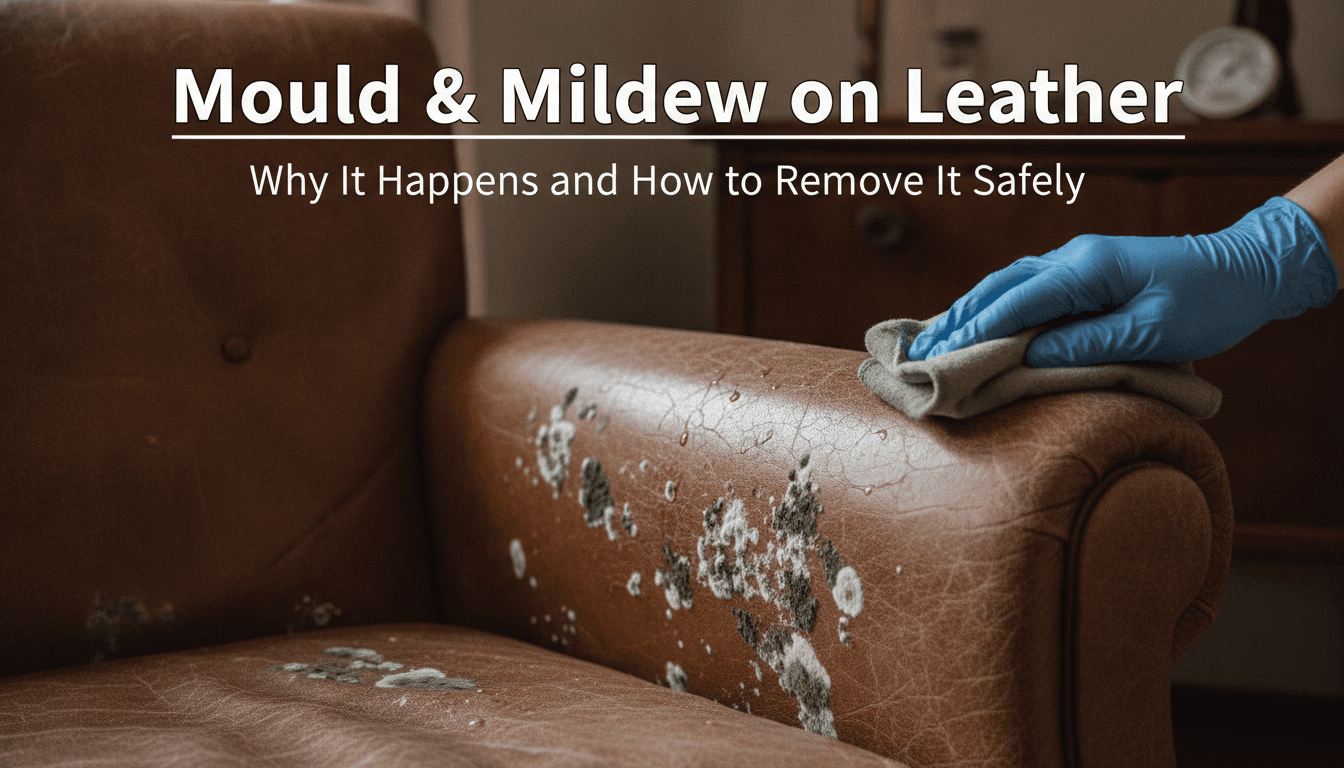
Mould on a leather jacket is a living growth feeding on what has collected in the hide, the dust, body oils and dressings, rather than on the leather itself. Caught early it lifts off cleanly, and it only marks the surface underneath once it has been left for months.
Take the item outside, let it dry fully, brush the growth away in open air, wipe the surface back, then dry it slowly and fix the storage that caused it. Never bleach it, never soak it, and never brush it while it is damp.
Why mould grows on leather
Mould does not arrive because leather is dirty. It arrives because four things line up at once, and a wardrobe is very good at supplying all four.
- Moisture. Not a puddle, just persistent damp air. Cold outside walls, unheated rooms, lofts, cellars, garages and the back of a fitted wardrobe all sit damper than the room they are in.
- Still air. Growth needs the air to stop moving. Garments packed shoulder to shoulder, or sealed in a plastic suit carrier, are effectively in their own private climate.
- Darkness and no disturbance. Growth needs very little warmth, just to be left alone. A cupboard that is rarely opened, in a room that is rarely aired, is close to ideal conditions.
- Something to eat. This is the part people miss. The growth feeds on skin oils, sweat, hair products, food splashes, dust, the starch in a lining and the fats and dressings used to keep leather supple.
That last point explains the pattern you usually see on the bench: growth is heaviest at the collar, the cuffs, the underarms and the inside of the lining, because that is where a person leaves the most behind. A jacket put away clean is far less appetising than one put away after a season of wear.
Not all leather is equally at risk. Heavily pigmented, coated leather has a sealed surface with little to offer. Aniline, semi-aniline and lightly finished hides are absorbent and oil-rich, so they are the ones that go furry first. Vegetable-tanned leather, older bags and belts especially, is the most vulnerable of the lot.
Mould, or something that only looks like it?
Three different things show up as a pale haze on leather, and they want three different responses. Getting this right before you touch anything saves a lot of trouble.
| What you see | What it probably is | The tell |
|---|---|---|
| Fuzzy grey, white, green or black spotting, with a musty earthy smell | Mould or mildew | It has texture and stands slightly proud of the surface. It comes back in the same spots if the storage does not change |
| An even, waxy white haze, no smell, no fuzz | Fat spew, the fats in the leather migrating to the surface | A warm cloth melts it away in seconds. It tends to return in cool conditions and is not a fault |
| Chalky white patches on suede or nubuck, often with a tide line | Salt or a dried water mark | Flat, not raised, and no smell. It needs suede treatment rather than mould treatment |
If a warm cloth clears it instantly and there is no smell, you had spew and the jacket is fine. If it is raised, patchy and smells earthy, treat it as mould.
How to remove mould on a leather jacket safely
Work outdoors if you possibly can, or by an open window, and wear gloves and a face covering. You are about to disturb a lot of spores, and brushing them off in a bedroom simply moves the problem into the room. Keep a badly affected item in a bag until you get it outside.
- Dry it fully before you touch it. Damp mould smears into the grain and drives colour into the surface. Hang the item somewhere airy and out of the sun until the leather and the lining are properly dry, which can take a day or more.
- Brush the growth off in the open air. A soft brush, light strokes, always away from you. The aim is to lift the growth off the surface, not to scrub it into the hide.
- Do the lining as well. On coats and jackets the lining is often worse than the shell. Turn sleeves through as far as they will go and treat the inside with the same care.
- Wipe the surface back. On finished leather, a cloth wrung out almost dry in plain water and nothing else, worked in small sections, then dried straight after with a second cloth. On suede, nubuck and shearling, no liquid at all.
- Dry slowly, in shape. Away from radiators, hot air and direct sunlight. Heat sets stains, shrinks hide and hardens the fibres.
- Then air it for days, not hours. Somewhere with moving air, on a broad hanger, with room around it. This is what stops the smell settling in.
- Feed it afterwards. Once bone dry, finished leather wants a suitable conditioner, because the growth and the cleaning both leave the hide thirstier than it was.
- Deal with the cupboard before the jacket goes back. Otherwise you are repeating this in a few months.
The things that make it worse
- Bleach. It destroys the tannage, strips colour and leaves the leather brittle. There is no dilution that makes this a good idea.
- Washing it, in a machine or a sink. Water driven right through a hide leaves it stiff, distorted and a size smaller, and nothing done afterwards puts that back.
- Household antibacterial and mould sprays. They are formulated for tiles and plaster. On leather they bleach, dry and leave residue.
- Vinegar, used blind. It is the standard internet answer and it does kill some growth, but it is acidic, it dulls and dries finishes, and it can move dye on aniline leather. If you use it at all, dilute it heavily, test somewhere hidden first, and keep it away from suede entirely.
- A hairdryer or a radiator. Fast drying is the most common cause of permanent damage in this whole process.
- Straight back in the wardrobe. Same conditions, same result, usually within a season.
Suede, nubuck and shearling need different handling
Napped surfaces have no protective finish to wipe. Everything you put on them soaks in, so the safe home approach is narrower.
Brush gently in the open air with a suede brush, work the nap in one direction, and stop there. No damp cloth, no vinegar, no soap. If the growth has darkened the nap or gone into the surface, that is a specialist job, because lifting it means treating the fibre without flooding it.
Shearling and sheepskin are harder again. Mould gets down into the wool, mats it, and holds smell long after the visible growth is gone, and the skin side can stiffen if it has been damp for a long time. Our suede and sheepskin jacket service covers both faces of the garment. If you are dealing with a shearling coat more generally, the sheepskin and shearling care guide goes through how these garments behave. For marks left behind on suede once the growth is off, getting stains out of suede covers the marks that respond and the ones that do not.
What comes back, and what does not
Being straight about this saves people money on items that are past helping.
Usually recoverable: surface growth on pigmented or finished leather, growth on a lining, light spotting caught in the first weeks, and most cases where the item was clean when it was put away.
Sometimes recoverable: growth on aniline and lightly finished leather that has left grey or purple shadowing. The growth comes off. The shadow may lighten a long way without fully clearing, and that is worth knowing before work starts rather than after.
Not a cleaning problem: stitching that has rotted after long damp storage, coated or bonded leather where the surface layer has lifted and is flaking, and hide that has gone hard and papery from years in a cellar. Old vegetable-tanned leather can also develop red rot, a powdery reddish crumbling that is often mistaken for mould. It is the structure of the leather breaking down, and no clean reverses it.
Where the jacket itself is sound, a full clean and re-oil is the sensible reset. Our leather jacket cleaning service covers that, and the wider leather garments service takes coats, trousers, gloves and the rest.
The smell is a separate problem
A jacket can come back visually clean and still be unwearable. Musty odour sits in the lining, the padding and the fibre, not on the surface, which is why more surface cleaning never shifts it and why perfumed sprays only layer on top of it.
Odour of that kind is treated as its own stage, with ozone treatment after cleaning rather than instead of it. Doing it in that order matters, because treating the smell before the growth is off simply leaves the source in place.
Stopping it happening again
The wardrobe is the actual problem in nearly every case that arrives here.
- Store clean. Body oils, sweat and hair products are the food supply. An item that has had a season of wear should be cleaned before it is put away for months.
- Store dry. A jacket that went in slightly damp after rain will grow something. Dry it properly first, away from heat.
- Let air move. Space between garments, and a breathable cotton cover if you use one. Plastic suit carriers and vacuum bags trap moisture against the surface.
- Pick the right room. Not the loft, the cellar, the garage or against a cold outside wall. An interior cupboard in a heated room is far safer.
- Manage the humidity. In a room that runs damp, a dehumidifier or moisture absorber does more good than anything you can put on the leather.
- Look twice a year. Take things out, air them, check the collar, cuffs and lining. Growth caught in its first weeks is a brush and an airing. Growth left for a year is a different conversation.
When to hand it over
Send it out when the growth covers a large area, when it has been there long enough to smell, when it is on suede, nubuck, shearling or fur, when the leather is aniline or vintage, when the lining is affected throughout, or when the item matters enough that a bad outcome is not acceptable.
Do it yourself when it is a few surface spots on a robust finished leather, caught early, and you can work outdoors.
We collect free across North London and the workshop is in Edmonton. Anywhere else in the UK can send an item in through the tracked postal service. If it is going in the post, let it dry out first and pack it in something breathable rather than sealed plastic, or a few days in transit will make the growth worse.