

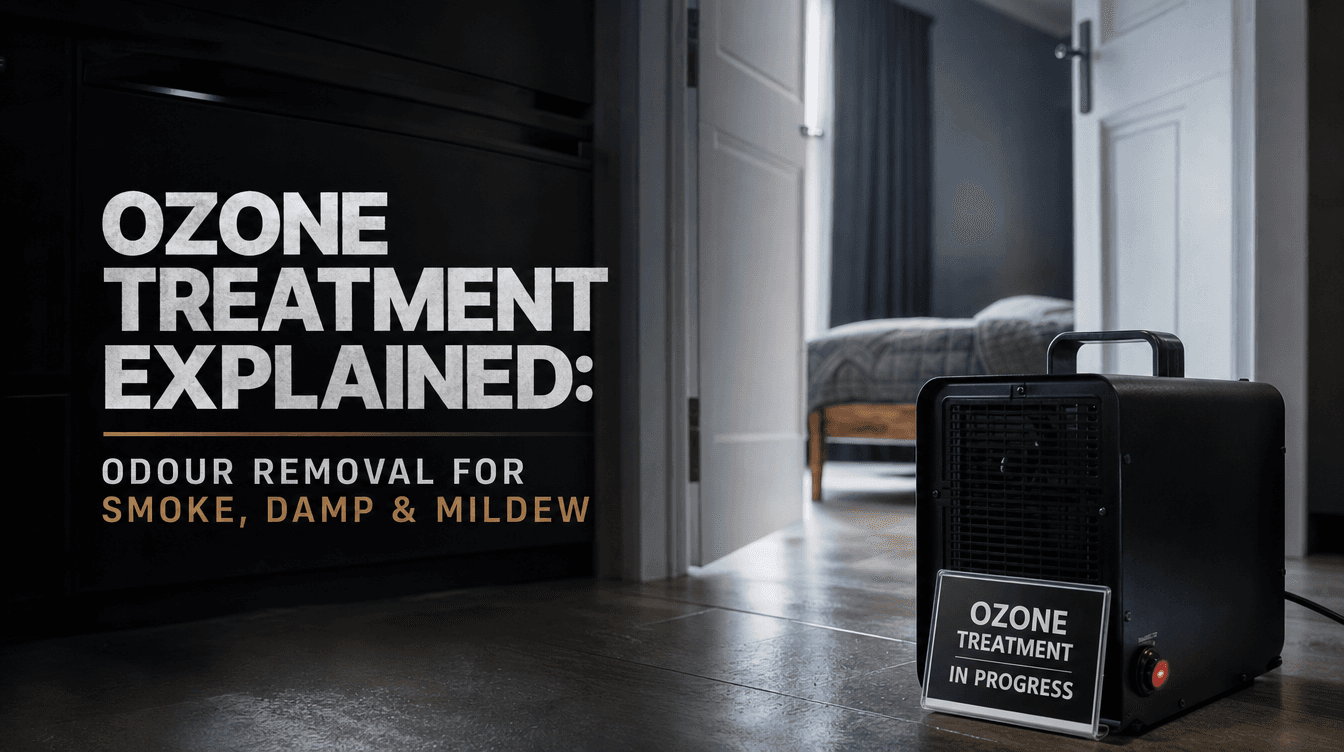
Ozone odour removal works by breaking down the molecules that cause a smell, rather than covering them with a fragrance. Ozone is an unstable form of oxygen, and when it meets smoke residue, the by-products of mould or the traces left by sweat and spills, it reacts with them and changes them into compounds that no longer smell.
That makes it one of the most effective ways to deal with odours that have worked deep into leather, suede, sheepskin, fur and heavy fabrics, where washing is either impossible or would do more harm than good.
What ozone is and why it works on smells
Ordinary oxygen in the air is made of two oxygen atoms bonded together. Ozone has three, and that third atom is only loosely held. It breaks away easily and attaches itself to whatever it touches, a reaction called oxidation.
Most unpleasant smells are made of organic molecules: tar and soot particles from smoke, gases given off by mould and bacteria, fatty acids from sweat. When ozone oxidises them, their structure changes and the smell goes with it. The ozone itself breaks back down into ordinary oxygen once the job is done, so nothing is left sitting in the item.
This is the key difference from an air freshener or a fabric spray. Those add a stronger, pleasanter scent over the top. The original smell is still there, and it tends to come back as soon as the perfume fades, often mixed with it.
Odours ozone deals with well
Ozone is used on most smells that come from something organic. The common ones are these:
| Odour | Where it usually comes from | Why it is hard to shift |
|---|---|---|
| Cigarette and cigar smoke | Smoking indoors, pubs, a smoker's car | Tar settles in the pores of leather and the fibres of fleece |
| Bonfire and house fire smoke | Garden fires, festivals, fire damage | Fine soot works deep into napped surfaces like suede |
| Damp and musty smells | Lofts, cellars, garages, cold wardrobes | Caused by mould and bacteria living in the material |
| Mildew | Items stored damp or packed away wet | The growth leaves its smell behind even after it is brushed off |
| Sweat and body odour | Collars, cuffs, underarms, linings | Builds up over years of wear in places that are never washed |
| Pet smells | Dogs, cats, animal bedding | Oils from fur and skin transfer to anything they lie on |
| Vomit and urine | Accidents, pets, young children | Need cleaning first, then ozone for what remains |
Each of these can soak into a material that cannot simply be washed, which is where ozone earns its place.
Odour removal from clothes and leather: why cleaning usually comes first
A smell is only a symptom. If the thing causing it is still in the item, the smell will come back, whatever you use on it.
- Mould and mildew need removing from the surface before the smell can be dealt with properly. Ozone kills mould spores, but the dead growth and its staining still need cleaning off.
- Urine and vomit leave deposits in the material. Until those are cleaned out, no treatment will leave the item fresh for long.
- Heavy soot from a fire sits on the surface as a physical layer. It has to be brushed and cleaned away before ozone can reach the smell trapped underneath.
That is why ozone works best as the second step, not the first. The cleaning removes what can be removed, and the ozone deals with the odour that has gone deeper than any cleaning can reach. On a lightly smoky or musty item that is otherwise clean, ozone on its own may be all it needs.
What can be treated
Because ozone is a gas, it reaches everywhere air does: inside seams, under collars, through linings and into padding. It does not need to be rubbed in, sprayed on or rinsed out, which is exactly why it suits materials that cannot go in water.
- Leather jackets and coats. Leather is porous, and smoke in particular settles into it. See our leather garment cleaning service.
- Suede, sheepskin and shearling. The fleece side of a sheepskin coat holds on to smells for years. Our sheepskin and shearling care guide explains why it should never be washed at home.
- Fur. Vintage and older furs often cannot take a full clean. For those, a gentler treatment using ozone kills bacteria in the skin and deals with the smell without a full clean. More on the fur cleaning page.
- Handbags, shoes and boots, where the lining and insole hold most of the smell.
- Wool coats, knitwear and heavy fabrics that have picked up smoke or a musty smell in storage.
- Rugs, hides and soft furnishings, including sheepskin rugs that have spent time on the floor of a smoky or damp room.
What ozone will not do
Ozone is very good at one thing, and it is worth being clear about its limits:
- It will not remove stains. Yellowing from nicotine, a tide mark from damp or the discolouration left by mould are marks in the material, not smells. They need cleaning, and sometimes colour work, on top.
- It will not repair damage. Leather that has dried out and cracked from heat, or suede scorched near a fire, is a repair job.
- It will not stop a problem coming back. An item that goes back into the same damp cupboard will start to smell again. Our guide to mould and mildew on leather covers storage that keeps it away.
- It will not fix the source in a room. If a whole house smells of smoke, treating one coat helps that coat, not the house.
Why you should not use an ozone generator at home
Small ozone machines are sold online for home use, and it is easy to see the appeal. We would advise against it for anything you value.
- Ozone is harmful to breathe. It irritates the lungs, throat and eyes, even at fairly low levels. Treatment has to happen in a sealed space with no people, pets or plants inside, followed by a proper period of airing.
- Too much does damage. Heavy or repeated exposure can dry leather, fade some dyes and perish rubber and elastic, including the elastic in cuffs and the rubber in some shoe soles and seals.
- You cannot see how much is enough. Getting the amount and time right for the material is the whole skill. Too little does nothing, too much causes harm.
What does help at home
For mild smells, a few simple habits make a real difference and carry no risk:
- Air it outside, in the shade. A few hours on a hanger in a breezy spot out of direct sun will lift a light musty or cooking smell. Keep suede and leather out of the rain.
- Let it dry before you put it away. Sweat and damp from a day's wear are what feed the bacteria and mould behind most wardrobe smells.
- Store it where air can move. A breathable cotton cover, not plastic, and a little space either side on the rail.
- Put odour absorbers near it, not on it. An open dish of bicarbonate of soda in the bottom of a wardrobe can help. Never sprinkle it directly on suede, fur or leather.
- Do not reach for perfume or fabric spray. On leather and suede, scented sprays can leave marks, and the original smell will return once the fragrance fades.
Booking ozone treatment
Ozone treatment can be booked as a service in its own right through our ozone treatment and odour removal page. It can also be added to any cleaning order when you book, and it comes included in the higher care levels offered at checkout.
We collect across London, and from further afield, items can come to us through our tracked postal service. If an item smells of damp, let it dry out and pack it in something breathable before it travels, so the smell does not get worse on the way.