

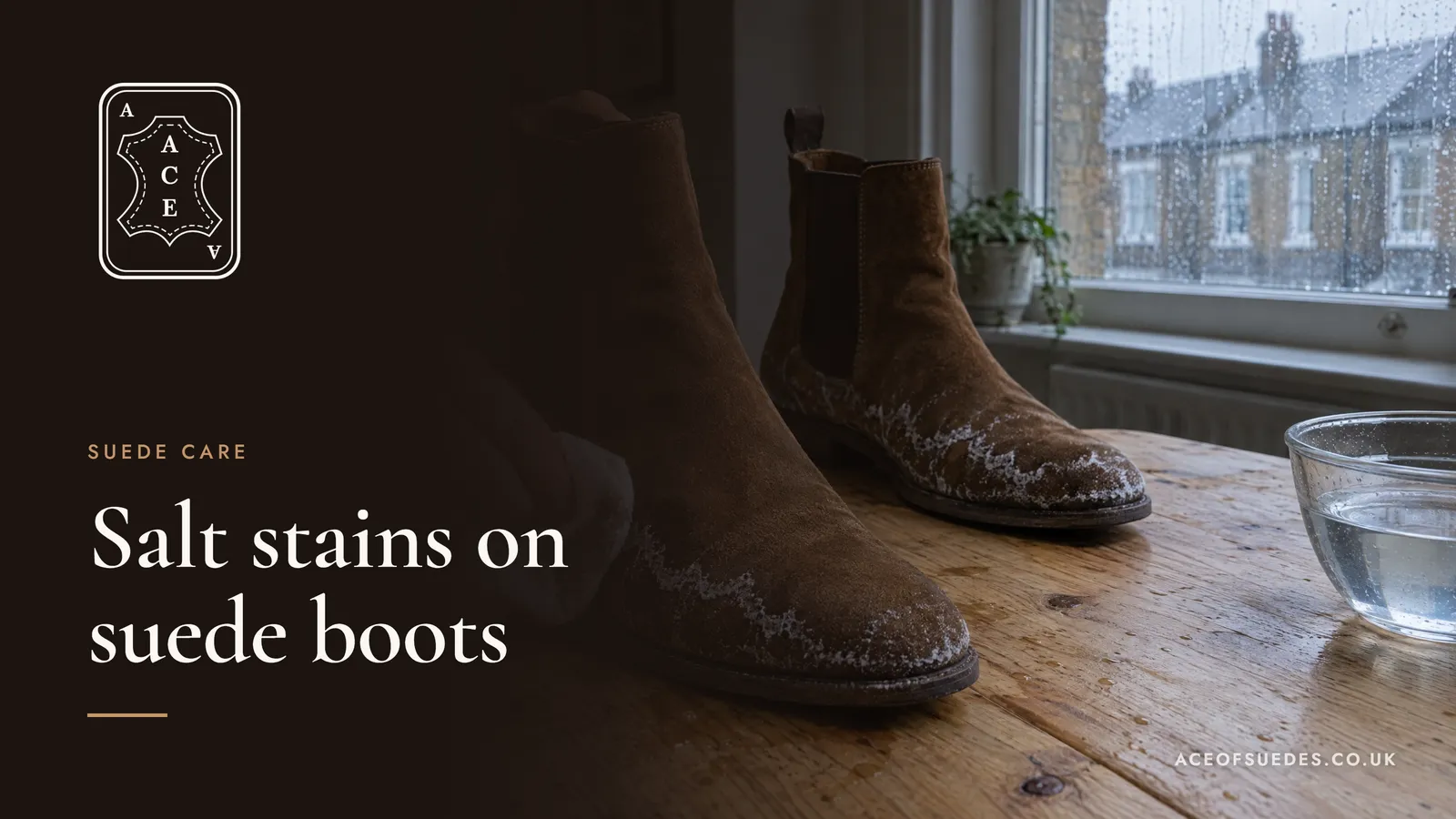
Salt stains on suede boots can usually be removed at home if you deal with them in the right order. Let the boots dry naturally first, brush out the loose crystals, then dab the white marks with a barely damp cloth and a little diluted white vinegar, working each one out to the nearest seam so no new edge forms. Dry slowly away from heat, then raise the nap again with a brush. If the leather has gone stiff, cracked or patchy in colour, stop there and get a specialist to look at it.
Where the white line comes from
When councils grit roads and pavements in a cold snap, the salt mixes with rain and slush into a brine. Every step you take splashes that brine onto the toes and lower sides of your boots, and suede, which has no sealed surface, soaks it straight into the nap.
While the boot is wet you barely notice. The trouble starts as it dries. The water leaves, the salt stays behind as fine crystals caught in the fibres, and those crystals show up as the chalky white waves you see the next morning. The mark forms where the wet patch ended, which is why it looks like a high-water line rather than a spot.
Salt that stays in the suede goes on pulling moisture from it, so over a winter the leather loses its softness and stiffens along the flex creases across the toe, sometimes cracking there. That is why the white mark is worth clearing even if you do not mind the look of it.
First aid when you come in from a salty walk
What you do in the first ten minutes decides how hard the job is later.
- Knock off the grit at the door. Tap the boots together outside or brush the welt and toe with a stiff brush while they are still wet, so you are not carrying sharp grit and extra salt into the drying stage.
- Blot, do not wipe. Press a dry towel against the wet areas to take up as much brine as you can. Wiping drags salty water further up the boot.
- Fill them out. Stuff each boot with plain white paper or kitchen roll, or slot in shoe trees, so the leather dries in its proper shape. Avoid newspaper inside pale suede, as the ink can transfer.
- Leave them somewhere cool and airy. Room temperature, out of direct sun and well away from radiators, fires and underfloor heating.
Then leave them alone. Trying to clean wet suede only moves the salt around and sets a bigger mark.
Lifting salt stains on suede boots once they are dry
Once the boots are completely dry, which usually means the next day, you can start on the marks.
1. Brush out the loose salt
Use a suede brush or a crepe brush and work over the whole marked area. A lot of the white is loose crystal sitting on top of the nap, and a firm, dry brushing will shift more of it than people expect. Brush in short strokes, first one way, then the other, and tap the boot over a bin to clear the dust.
2. Test your cleaning mix out of sight
Stir a small splash of white vinegar into a bowl of cool water. Dampen a corner of a clean, pale cloth, wring it until it is barely wet, and dab it on a hidden area such as the inner side of the shaft near the heel. Let that patch dry fully. If the colour has stayed even, carry on. If it has darkened or lightened, stop: that suede needs professional cleaning rather than a home fix.
3. Dab the white marks, then feather them out
Salt dissolves in water, so the aim is to redissolve the crystals and lift them into the cloth, not to push them around. Dab the mark lightly with the barely wet cloth, starting at the white edge. Then keep dabbing outwards, lighter and lighter, until you reach a natural break such as a seam, the welt or the edge of a panel.
Here is where home cleaning usually goes wrong. If you clean only the white line and stop in the middle of a panel, you create a fresh damp edge, and when it dries you have swapped one ring for another. Taking the moisture to a seam gives it nowhere to form a line.
4. Blot and repeat once if needed
Press a dry cloth over the area to draw up the loosened salt. On a heavy mark, let the boot dry and repeat steps 3 and 4 one more time. Two gentle goes are far safer than one heavy soaking.
5. Dry slowly, then lift the nap
Re-stuff the boots and leave them to dry naturally again. When they are bone dry, brush the whole area to raise the nap, and use a suede rubber on any spot that has dried flat or slightly stiff.
Light, dark and nubuck boots behave differently
The method above suits most suede boots, but the colour and the finish change what you need to watch.
| Boot | What to watch | What to do differently |
|---|---|---|
| Sand, taupe or pale grey suede | Shows every water edge, so a careless clean leaves a visible ring | Always feather the moisture to a seam, and use the lightest damp possible |
| Dark brown, navy or black suede | Salt shows up starkly white, and some dyes can come off onto a cloth | Use a white cloth and check it after each dab; stop if colour is coming away |
| Nubuck | Tighter, finer nap that flattens and marks under a stiff brush | Same steps, but brush gently and rely on the rubber more than bristles |
| Lined winter boots | Thick linings hold moisture for a long time | Allow much longer drying before you touch the outside, or the salt keeps rising |
If you are not sure whether your boots are suede or nubuck, our guide to suede vs nubuck vs leather explains how to tell them apart.
Home fixes that backfire on salt
Each of these turns a salt mark into a harder job:
- Drying them fast. A hairdryer or a radiator pulls the water out in a hurry, leaves the salt locked in place and can shrink and harden the leather.
- Scrubbing with soap or washing-up liquid. Detergent leaves its own residue in the nap and tends to darken suede in patches.
- Using smooth leather products. Polish, cream and saddle soap are made for finished leather. On suede they clog the nap and leave greasy dark areas.
- Putting suede boots in the washing machine. The soaking and tumbling can ruin the shape, the nap and the glued parts of the boot.
- Cleaning just the white line. As above, this moves the ring rather than removing it.
- Rubbing a marker or dye over the mark. It hides the salt for a while but makes a proper clean and recolour much harder later.
When salt has done more than stain
A white mark on its own is cosmetic. It is time to stop the home attempts and get a specialist to assess the boots when you see any of these:
- The toe creases have gone hard, or you can see fine cracks opening along them.
- The colour has gone blotchy or faded where the salt sat, rather than just looking dusty.
- The white keeps coming back after two careful cleans, which means there is still salt deep in the leather.
- The boots are expensive, hard to replace or a designer pair you would not want to risk.
- Something else is mixed in with the salt, such as oil from the road or a dark stain from wet jeans.
None of those mean the boots are finished. They mean another round at the kitchen table is more likely to harm them than help.
How to keep salt off suede boots this winter
A little preparation before the first frost saves most of the work above.
- Proof clean boots before the season. Spray clean, dry boots with a suede protector before the first frost and again after any clean, following the timings on the can. It slows brine down rather than stopping it.
- Brush after every salty outing. Once the boots are dry, a quick brush the same evening clears crystals before they work deeper. Keeping a suede brush by the door makes this a habit.
- Give each pair a day off. Wearing the same boots day after day means they never dry out completely. Rotating pairs gives each one a proper chance to dry between wears.
- Save your best suede for dry days. On mornings when the pavements are white with grit, a pair of smooth leather or rubber boots will take the punishment far better.
For routine care the rest of the year, our everyday suede shoe care guide covers the basics, and for marks other than salt, our stain-by-stain suede guide works through them one at a time.
Getting salt-damaged boots cleaned by a specialist
Our footwear service cleans and treats each pair entirely by hand, then finishes it to suit the boot.
The work is done at our Edmonton workshop, on everything from everyday ankle boots to designer pairs. You can see what is included and book in on our footwear cleaning service page.
If you live in or around London, we collect and deliver, with no collection charge once your order reaches £50. Nearer the workshop, our North London page sets out the local collection details. Anywhere else in the UK, our tracked postal service lets you send your boots in and have them returned to your door.