

Sheepskin coat cleaning is not a washing machine job, and it is not a standard high street dry clean either.
A shearling coat is a single hide with the wool still attached, so the skin side and the fleece side have to be treated together in a process that keeps the natural oils in the leather.
At home your job is upkeep: brush the fleece, air the coat after wear, dry it slowly if it gets wet, and store it properly over summer. Once it is grubby, flat or smells musty, it needs a specialist.
What sheepskin and shearling actually are
This sounds like a technicality. It is actually the one idea that explains every other instruction on this page.
Sheepskin is a hide with the wool left on. Shearling is that same hide taken from a sheared animal, with the wool cropped back to an even depth so it sits neatly as a lining.
Trade names such as double-face and Toscana describe how the piece is finished and how long the wool is left, but the principle is the same: one skin, suede or nubuck on the outside, fleece on the inside, permanently joined.
Two things follow from that, and they govern everything below.
The leather side stays supple only because of the fats and oils worked into it at the tannery. Take those out and the skin hardens.
The wool side is not a lining you can unpick and wash separately. Whatever soaks the fleece soaks the skin behind it, and whatever dries the skin out does its damage under the wool, out of sight, while the coat still looks perfectly fine on the hanger.
Why an ordinary clean ruins a sheepskin coat
A sheepskin coat that is beyond saving has often not worn out at all. It has been cleaned by the wrong process once.
Solvent dry cleaning. Conventional dry cleaning is designed to lift grease out of fabric, and it pulls the fats out of a sheepskin along with the dirt.
The skin comes back dry, boardy and often a shade patchier than it went in, and it will not soften again on its own.
It is why plenty of high street cleaners will not take sheepskin over the counter at all, and why the honest ones pass it straight to a specialist.
Washing machines and hand washing. Water plus agitation shrinks the skin and felts the wool into hard little clumps. Coats come back from a home wash noticeably smaller than they went in, with sleeves that stop short of the wrist. That change is permanent.
Heat drying. A radiator, an airing cupboard or a hairdryer will cook the skin. It curls, stiffens and can crack along the fold lines.
I would rather someone brought me a filthy coat than a shrunken one. Dirt comes out. A skin that has been dried out and shrunk is one of the few things in this trade that cannot be fully put back.
Everyday care between cleans
Most of the life of a sheepskin coat is looked after by small habits, not by cleaning.
Groom the fleece
The wool flattens where it rubs, so the collar, the cuffs and the front edges go limp first.
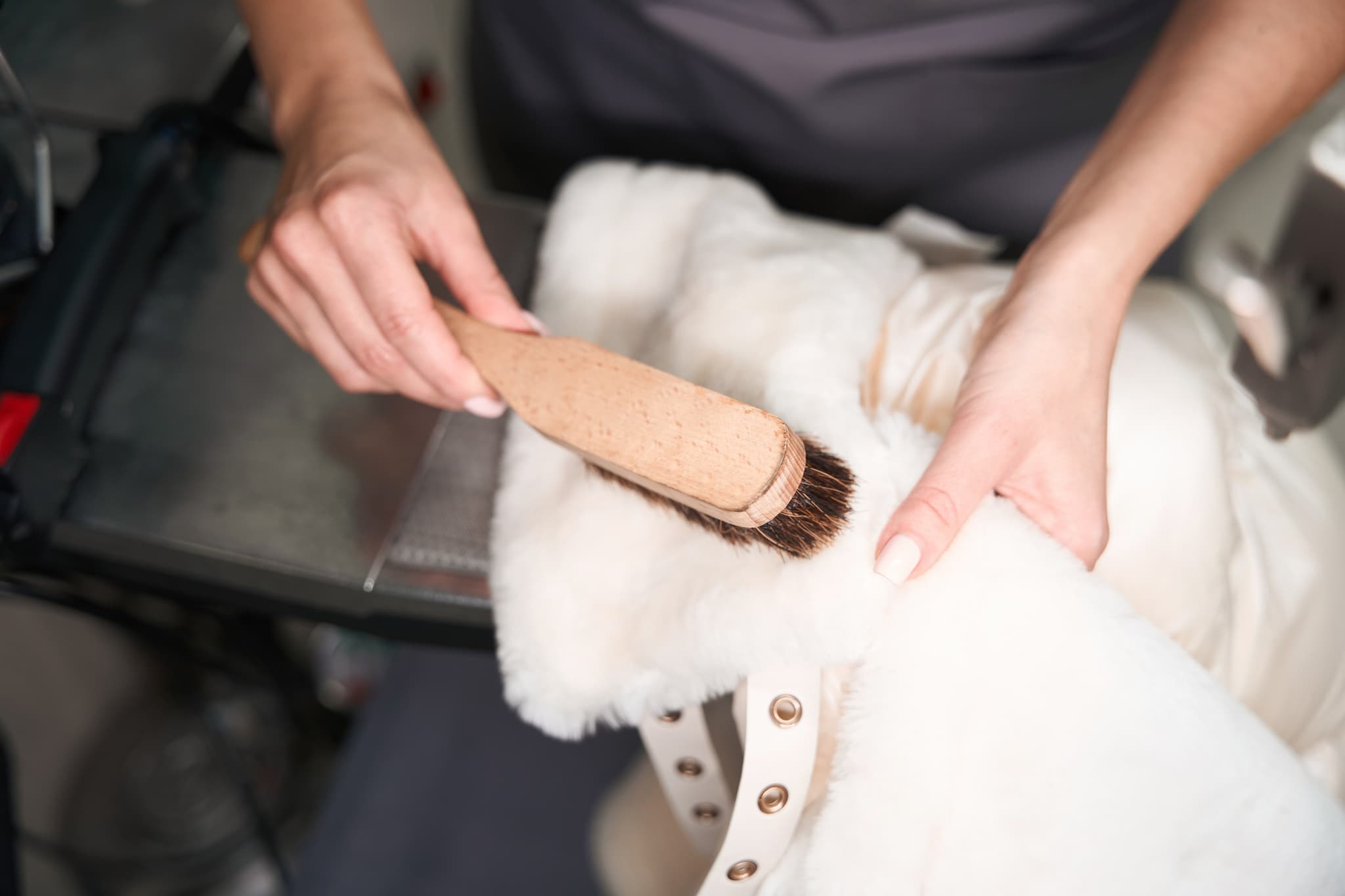
Work through them every few wears with a soft-bristled brush or a fine pet slicker, using short light strokes to separate the fibres and lift them back up rather than dragging the brush through in one pass.
Cropped shearling only needs a light going over. Long-haired wool needs more patience and a gentler hand.
Keep the outer skin standing
The suede or nubuck face collects dust that dulls the colour long before it looks dirty.
A brush over the shoulders, the seat and the back of the sleeves after wear is enough most of the time. Pay attention to the shoulder line, which takes the most light and shows fading first.
Hang it right
Use a broad wooden hanger that supports the shoulder properly. A thin or wire hanger will dent the skin from the inside, and those dents set.
Never leave the coat in a plastic dry cleaning bag: it holds moisture against the wool, which is how musty smells and mould start.
Air it after wear
Twenty minutes on a hanger somewhere with moving air, away from direct sun and heat, does more for a sheepskin than any spray. Body warmth and moisture go into the fleece every time you wear it, and airing lets them out again.
Do not lean on a protector spray
Sheepskin leaves the tannery with its oils and any water-repellent finish already worked into the skin, and those wear down with use.
A consumer protector spray adds a little surface resistance to the suede face and does no harm on a well-brushed coat, but it cannot replace what has gone from inside the leather.
Only a proper clean and re-oil does that, which is why a coat seen to at the end of each season keeps its handle for years.
Rain, damp and spills
Sheep are outdoor animals and their skin copes with weather better than people expect. What it does not cope with is being dried fast.
- Light rain. Shake off the surface water, hang the coat somewhere cool with air around it and leave it. It will be fine.
- A proper soaking. Same principle, more time. Hang it well away from any heat source and let it dry over a day or two. Expect the skin to feel firmer than usual once it is dry. That is the oils having moved, and it is a good moment to have the coat professionally cleaned and re-oiled rather than waiting for it to stiffen further.
- Spills. Lift what you can with a dry cloth, then leave it alone. Anything from under the kitchen sink, and the wipes in the bathroom cupboard, will take the finish off the skin and leave a paler ring exactly where you rubbed.
- Snow and road salt. Brush it off once dry, never wipe it wet, and do not leave salt sitting on the skin over a weekend.
Smells live in the fleece
Wool is absorbent, which is exactly why it is warm, and it is also why a sheepskin coat picks up smoke, cooking, damp and body odour more readily than a leather jacket does. Airing clears the everyday stuff.
A smell that will not shift is telling you something. A sour or musty note usually means moisture has been sitting in the fleece, and that is often the first sign of mildew starting where you cannot see it. That is a case for a proper clean plus ozone odour treatment, which neutralises the odour at source instead of covering it with perfume.
Moths treat sheepskin as a meal
Clothes moth larvae eat keratin, and a fleece lining is one of the richest sources of it in a house. Add the trace of body oil and skin left after a season of wear and a stored sheepskin coat becomes a target.
What to look for:
- Thin or bald patches in the fleece, especially in folds, under the collar and inside the cuffs.
- A fine gritty dust in the creases, which is larvae droppings and not dirt.
- Small pale casings or webbing tucked into seams.
- Grazed patches on the suede side where the pile has been eaten short.
Prevention comes down to two habits: have the coat cleaned before it goes away for the summer, because soiling is what attracts them in the first place, and take it out to air and inspect at least once during the storage months. Cedar and lavender are mild deterrents at best.
If you find live larvae, the wardrobe needs treating as well as the coat, and that is our moth treatment and prevention service.
Storing a sheepskin coat over summer
This is the step most people skip, and it causes more damage than a whole winter of wear.
- Clean it first, not in autumn. Storing a coat dirty bakes the soiling in for six months and rings the dinner bell for moths.
- Make sure it is bone dry before it goes anywhere.
- Use a breathable cotton cover, or no cover at all. Never plastic, and never a vacuum bag. Compressing the fleece for months crushes the wool flat and it does not always come back.
- Hang it with room around it on a broad hanger, so nothing presses a permanent crease into the skin.
- Choose the right spot. Cool, dark, dry and ventilated. Not the loft, not a cellar, not pressed against an outside wall or a radiator.
- Check it in midsummer. Five minutes with the coat on a hanger in fresh air, plus a look through the fleece, catches a moth problem while it is still small.
What professional sheepskin coat cleaning involves
People imagine a machine and a chemical. In practice it is a sequence of judgements about one specific hide.
Assessment first. I look at the type of skin, how the wool is finished, where the wear and staining actually sit, and how much oil is left in the leather.
Trims, knitted cuffs and any fur or leather panels are noted, because they may need to be handled differently from the body of the coat. Anything that looks likely to move colour gets tested in a hidden spot before anything else happens.
A wet clean formulated for skin-on-wool. The cleaning agents used on sheepskin are chosen to lift soiling while leaving the fats in the leather, which is precisely what a solvent clean fails to do. The fleece and the skin are cleaned in the same process because they are the same piece of material.
Controlled drying and re-oiling. The coat is dried under control and the skin is worked as it dries so it stays soft rather than setting hard, then re-fed with oils to replace what the cleaning has taken. This stage is where the difference between a specialist and a general cleaner really shows.
Finishing. The fleece is lifted and groomed back, the suede nap is re-raised, and where the colour has faded on the shoulders or the cuffs it can be re-finished by hand. Recolouring is a separate skill and a separate job from cleaning, so it is assessed and quoted on its own.
An honest verdict. Some things do not come back. A skin that has already been shrunk or hardened, perished stitching along a seam, and fleece that moths have eaten down to the skin are all beyond cleaning, although a hole or a failed seam can often go through repair and alterations. You will hear that from me before any work starts, not afterwards.
What you can handle, and what needs a specialist
Half of looking after one of these coats is knowing which half is yours.
| What you are seeing | Your move | Why |
|---|---|---|
| Fleece flattened at the collar and cuffs | Brush the wool back up | Grooming keeps the pile open; it is not a cleaning job |
| Caught in the rain | Hang and dry slowly, away from heat | Fast drying is what hardens a skin |
| Skin feels stiff after a soaking | Book a clean and re-oil | The fats have shifted and need replacing |
| A fresh spill | Blot dry, then leave it | Soap and solvents strip the finish and leave a ring |
| Collar or cuffs darkened and slightly greasy | Book a clean | Body oil is ingrained, not sitting on the surface |
| Musty smell that airing has not shifted | Book a clean plus odour treatment | Moisture is held in the fleece and mildew may have started |
| Fleece grey, flat and clumped throughout | Book a clean | The wool is lifted and groomed as part of the process |
| Colour faded across the shoulders | Ask about hand re-finishing | Recolouring is a separate job, and priced separately |
| Grit in the creases or bald patches in the wool | Isolate the coat, then book treatment | Moths mean the wardrobe needs doing as well |
| Season over, coat about to go away | Have it cleaned first | Soiling sets over summer and draws moths in |
That last row is the most valuable and the least used. A coat cleaned before it is put away comes out of the wardrobe in autumn ready to wear, and it stays out of the repair pile.
Where your coat goes from here
Sheepskin and shearling are cleaned at our Edmonton workshop, and every coat is inspected before any work begins. Full detail and current pricing sit on the suede, sheepskin and shearling garment cleaning page.
A few pieces route elsewhere. Sheepskin rugs, hides and skins are their own rug, hide and skin cleaning service, because the soiling underfoot and the finishing are nothing like a garment.
Coats carrying a real fur collar or a Toscana trim have that trim handled through our fur cleaning work. And if the suede face has taken one specific mark rather than a season of general wear, getting stains out of suede sets out what is worth trying yourself first.
Collection runs across North London. Further afield, the postal service lets a coat be sent in from any UK address, with tracking on both legs of the journey.
To book a coat in, start from the suede, sheepskin and shearling service page. Every coat is inspected and its price confirmed before any work begins.