

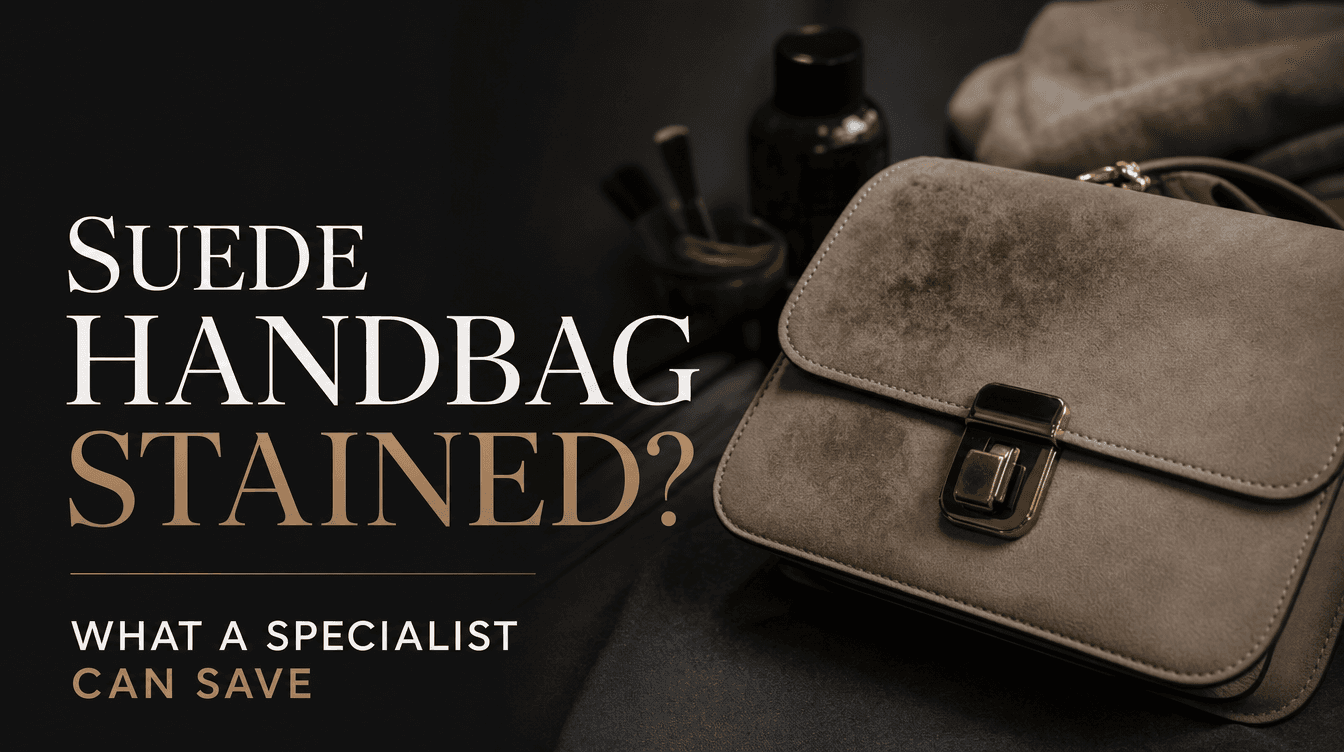
Suede handbag cleaning is decided by the construction of the bag as much as by the mark on it. A handbag is glued, lined, padded and stitched around a shape, so a specialist has to lift the mark without wetting the panel through to the adhesive underneath.
Most everyday damage does lift: shine on the handles, general grime, dye picked up from clothing, water rings, flattened nap on the corners. Ink, bleach and old oil are the ones that rarely clear completely.
Why a bag is a harder job than a shoe or a jacket
People are often surprised that a small bag takes more thought than a full-length coat. The reason is what sits behind the suede.
A suede jacket is, in the main, one material with a lining, and it can be worked on both faces. A bag is a laminated object. The outer suede is usually bonded to an interfacing or a stiffener to hold the shape, that sits against padding or board in the base and the sides, and the lining is stitched or glued in so you cannot get behind the panel you are working on.
That single fact drives everything:
- Moisture cannot be allowed to travel. Enough water to flush a mark out of the nap is often enough to reach the adhesive, and adhesive that lets go shows as a bubble, a ripple or a soft edge that no amount of cleaning puts back.
- There is no drying it flat. A bag has to dry supported in its own shape, or the panels dry distorted and the base sags.
- A bag is rarely one material. Suede body, finished leather trim, piping, a patent base, metal feet, a chain strap, a fabric or leather lining. Each wants different handling, and they are all within a few centimetres of each other.
- The inside gets its own treatment. Powder, pen, make-up and food inside the lining are ordinary, and they are a separate job from the outside.
- Hardware complicates access. Studs, feet, plates and chain fittings mask the suede immediately around them, which is exactly where dirt collects.
What a specialist can usually save
These are the most common problems on suede bags, and the honest expectation for each.
| What is wrong | What usually happens |
|---|---|
| Shiny, darkened handles and grab areas | Cleans up well. The nap is crushed and loaded with hand oils, and lifting the fibre is a large part of what specialist work is |
| Overall grubbiness and dulled colour | Cleans up well, and the difference is usually bigger than owners expect |
| Dye transfer from denim or a coat | Often improves a long way. Fresh transfer responds better than transfer that has been carried for a year |
| Water rings and rain spotting | Usually clears, because the fix is even treatment of the whole panel rather than spot work |
| Flattened, bald corners and base edges | Improves. How much depends on whether the nap is crushed or actually worn away |
| Light scuffs and rub marks | Usually clear |
| A musty smell from storage | Treatable, but as a separate stage from cleaning |
| Interior marks on the lining | Usually improve, though linings vary enormously in what they will take |
What usually cannot be put back
Being straight about this matters more than the sales pitch, because the wrong expectation costs someone money on a bag that was never coming back.
- Ink that has sat in the nap. Fresh and tiny is occasionally lucky. Anything that has spread along the fibres has dyed them, and lifting it usually means lifting the colour with it.
- Bleach and chemical marks. Hand sanitiser, perfume, hairspray and nail varnish remover strip colour where they land. That is a missing dye problem, not a dirt problem, so cleaning does nothing for it.
- Old oil that has darkened the leather itself. Once grease is through the nap and into the skin, the dark patch is in the structure.
- Suede worn through to the base leather at a corner or along a strap edge. There is no nap left to raise.
- Delamination. Where the outer has come away from its stiffener and gone bubbly, the fault is in the construction rather than the surface, and it rarely goes back invisibly.
- Splits and tears in the panel. These are repair questions rather than cleaning ones, and some are worth doing while others are not.
- Dyes that have already run from a cheap lining into the suede in damp conditions.
For the stain-by-stain detail on what does and does not respond, our guide to getting stains out of suede goes through each type in turn.
The grey area: cleaning versus recolouring
A lot of bags arrive where cleaning alone will not reach the result the owner has in mind, and the honest conversation is about recolouring.
Cleaning lifts what is sitting in and on the nap. Recolouring puts pigment back where it has gone. They are different jobs with different outcomes. Recolouring can transform a faded or patchy bag, but it changes the character of the suede slightly, it is not sensible on every finish, and on a two-tone or heavily branded piece it needs care to keep the edges honest.
The decision comes down to whether the colour is dirty or genuinely absent. Dirty responds to cleaning. Absent does not, and no amount of extra cleaning turns one into the other. Any bag that might need it is assessed and discussed before work starts rather than after.
How suede handbag cleaning is done at the bench
- Assessed in daylight, inside and out. Emptied, pockets checked, lining checked, and the suede looked at for finish, colour stability and where it has worn thin.
- Tested somewhere hidden. Under the base, inside a flap, behind a strap fitting. This is where you learn whether the colour is stable and how the nap behaves before anything is done in view.
- Hardware and trims protected. Metal, patent and contrast leather are worked around and shielded rather than treated the same as the suede.
- Dry work first. Loose dirt and crushed nap are addressed before any moisture is introduced, because a good deal of what looks like staining is dirt held in a flattened nap.
- Controlled work on the marks. Panel by panel, with the least intervention that shifts it, and moisture kept where it is wanted rather than allowed to spread to an edge.
- Dried in shape and supported. Filled out so the bag holds its form while it dries, slowly, away from any heat.
- Nap raised and finished. The fibre brought back up, edges tidied, and protection applied where it suits the piece.
- Interior dealt with separately, and odour treated as its own stage with ozone treatment where the smell is in the lining rather than on the surface.
What owners do that closes off the options
Nearly every bag that arrives beyond help was made worse after the accident, not during it.
- Baby wipes. They are behind a great many of the permanent pale patches on suede bags, because they carry detergent and moisture down into the nap and lift colour along with the dirt.
- Washing-up liquid and water. It floods the nap, reaches the adhesive and dries with a hard rim wherever the damp stopped.
- Scrubbing a wet mark. It mats the nap into a shiny patch that then has to be lifted separately from the stain.
- Drying it on a radiator. Heat sets the mark and stiffens the leather and the glue lines.
- Hanging a wet bag by its handles, which stretches the handle and drags the panel out of shape.
- Colour pens and shoe dye used freehand. They read as a fix for a day and make a proper recolour much harder afterwards.
If something goes on a bag, the most useful thing you can do is blot it, let it dry, and leave it alone.
Keeping a suede bag good between cleans
- Protect it before its first outing, not after the first mark. A suitable suede protector on a clean bag does far more than one applied over dirt.
- Keep it away from dark denim. Indigo transfer onto pale suede is one of the most common problems on light bags, and it happens through normal carrying rather than through any accident.
- Store it stuffed and standing. Paper or a cloth insert inside, upright on a shelf, so the shape holds and the base does not collapse.
- Use the cotton dust bag, never a plastic one. Plastic traps moisture against the suede and invites mould.
- Do not hang it by the handles for months. Handles stretch and the panel below them distorts.
- Brush it now and then. A light brush over the handles and corners keeps hand oils from building into a shine.
- Deal with a mark early. A fresh mark is a cleaning job and an old one is often a recolouring job.
Getting a bag looked at
The most useful thing to know before spending anything is what is realistic, which is why every bag is assessed and the outcome discussed before work is agreed. Our handbag cleaning service covers suede, leather and mixed-material bags, and belts, gloves, purses and smaller pieces go through the bags, belts, gloves and accessories service. Where a handle, a strap or stitching has gone, that is handled as a repair alongside the clean.
We collect free across North London, including Tottenham, and bags come to us from all over the UK on the tracked postal service. If you are posting one, fill it out and box it rather than squashing it into a mailing bag, so it arrives in the shape it left in.